Info
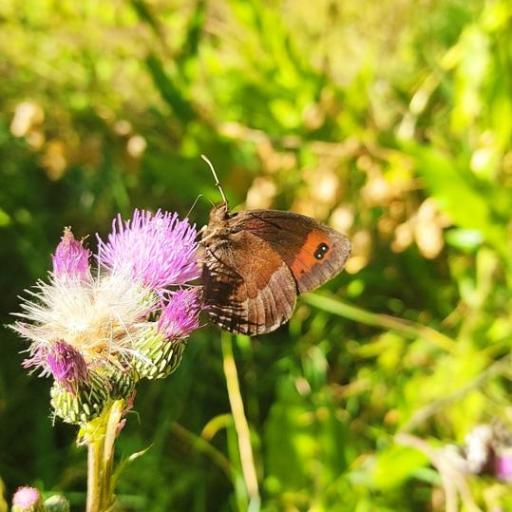
Commonly known as the Autumn Ringlet, this velvety butterfly is a late-season treasure of the European mountains. While many butterflies begin to vanish as the heat of summer fades, Erebia neoridas emerges to grace rocky meadows and forest edges with its deep, chocolatey hues. It is a peaceful "friend" of the garden and hillside, serving as a gentle pollinator during the transition into autumn.
🔍 How to Identify
- 🦋 The Wings: The upper wings are a rich, dark espresso brown, decorated with a vibrant orange-red band that contains two distinct white-pupilled eyespots near the tip.
- 👁️ The Eyespots: These "ocelli" are the butterfly's primary defense; they mimic the eyes of a larger creature to startle birds or deflect attacks away from its fragile body.
- 🪨 Underside Camouflage: When its wings are closed, the underside is a mottled, stony grey-brown. This allows it to disappear completely against the limestone rocks or dry bark where it frequently rests.
🌲 Habitat & Ecology
- 🌾 Grassy Nurseries: The larvae (caterpillars) are picky eaters, feeding almost exclusively on specific wild grasses like Festuca (Fescue). They spend the winter as young larvae, tucked away in the base of grass tufts.
- 🏔️ Mountain Preference: You will typically find them at moderate altitudes (up to 1,500 meters) in Southern Europe. They love "sun-traps"—pockets of warm air protected from the wind by rocks or shrubs.
- 🌼 Late Bloomer: Unlike many of its cousins in the Erebia genus that fly in mid-summer, this species waits until August and September to take flight, taking advantage of late-season nectar sources.
⚠️ Safety & Toxicity
- ✅ Harmless: The Autumn Ringlet is entirely safe for humans, children, and pets.
- 🛡️ Non-Aggressive: It has no sting or bite. Like most butterflies, its only defense is its erratic flight and camouflaged wing patterns. Touching their wings should be avoided, as it can rub off the delicate scales needed for flight.
✨ Fun Fact
The Autumn Ringlet is a "sun-worshipper." Because it lives in cooler mountain air, it often spreads its wings flat against dark rocks to soak up solar heat, acting like a tiny biological solar panel to warm its flight muscles!
More Details








