Info
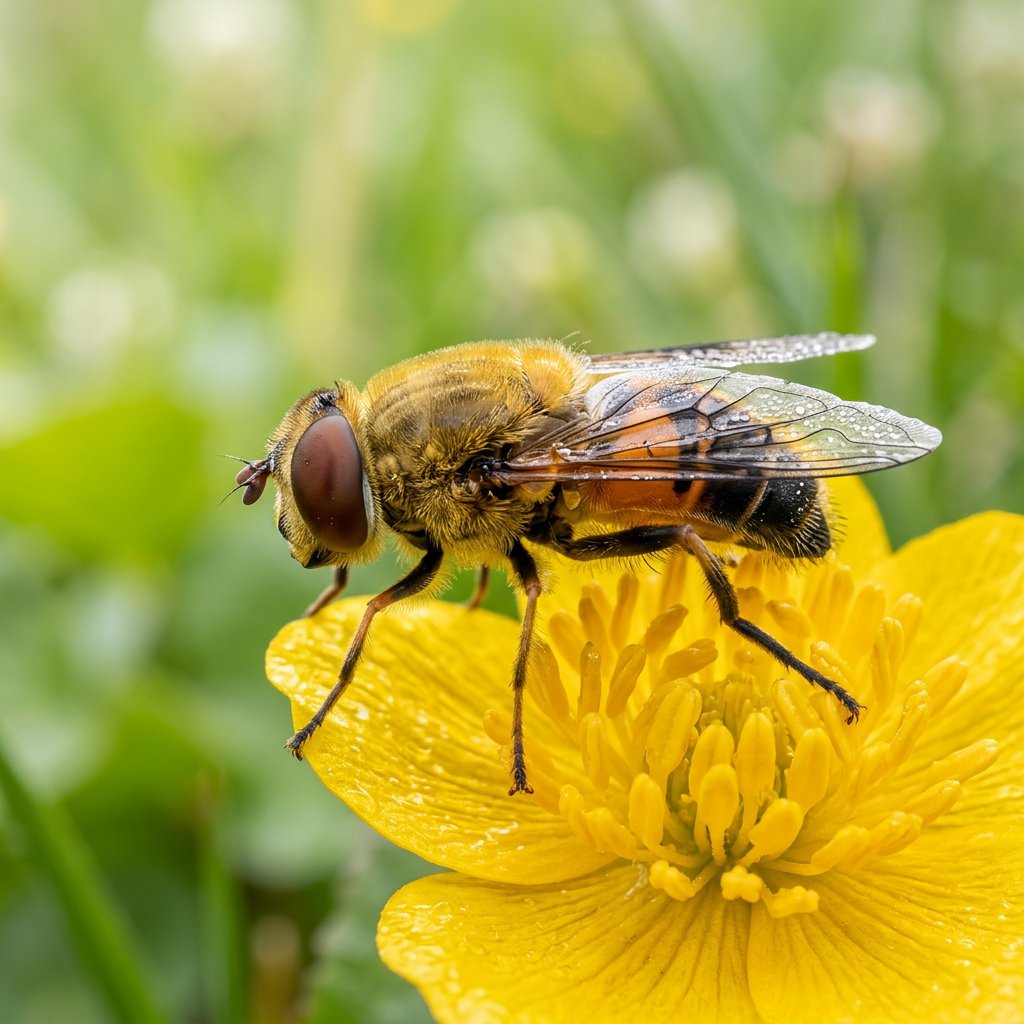
Meet the Drone Fly, nature’s ultimate "stunt double." Often mistaken for a honeybee due to its fuzzy body and golden-orange markings, this master of disguise is actually a harmless hoverfly. In ancient times, people often confused these flies with bees so frequently that they gave rise to the "Bugonia" myth—the belief that honeybees were spontaneously born from the carcasses of dead oxen.
🔍 How to Identify
- 🐝 The Bee Disguise: It mimics the European Honeybee almost perfectly with a stocky, hairy body and dark abdomen marked with two large, triangular orange-yellow patches.
- 👀 The "Wraparound" Eyes: Unlike bees, its eyes are massive and take up most of its head. In males, the eyes actually touch each other at the top, a feature never seen in bees.
- 🪽 Single Pair of Wings: As a true fly (Diptera), it has only two wings, whereas the bees it mimics have four. It also features a unique "spurious vein" in the wing that doesn't connect to any other veins.
🌲 Habitat & Ecology
- 🌼 Pollinator Extraordinaire: You will most likely find adults hovering over flat, open flowers like daisies, cosmos, or ivy. They are vital pollinators, often staying active in cooler weather when honeybees have already tucked away for the season.
- 💧 The "Rat-Tail" Larvae: The young live a very different life. Known as "rat-tailed maggots," they inhabit stagnant, oxygen-poor water (like farm runoff or gutters). They breathe through a long, telescopic tube that acts just like a snorkel, allowing them to scavenge for nutrients underwater.
⚠️ Safety & Toxicity
- 🛡️ All Bark, No Bite: Despite its "stinger-ready" appearance, the Drone Fly is completely harmless. It possesses no stinger and no mandibles for biting. It relies entirely on its resemblance to a bee to scare away predators.
- 🐕 Pet & Human Safety: They are safe around kids and pets. However, avoid letting pets drink from highly stagnant, polluted water sources where the larvae live, as accidental ingestion of the larvae can occasionally cause minor intestinal irritation.
✨ Fun Fact
🚀 The Original Drone: The Drone Fly is a master of "high-frequency hovering." It can remain perfectly stationary in mid-air despite heavy winds and can dart in any direction in the blink of an eye, a level of aerial agility that inspired the naming of modern mechanical drones.
More Details








