Info
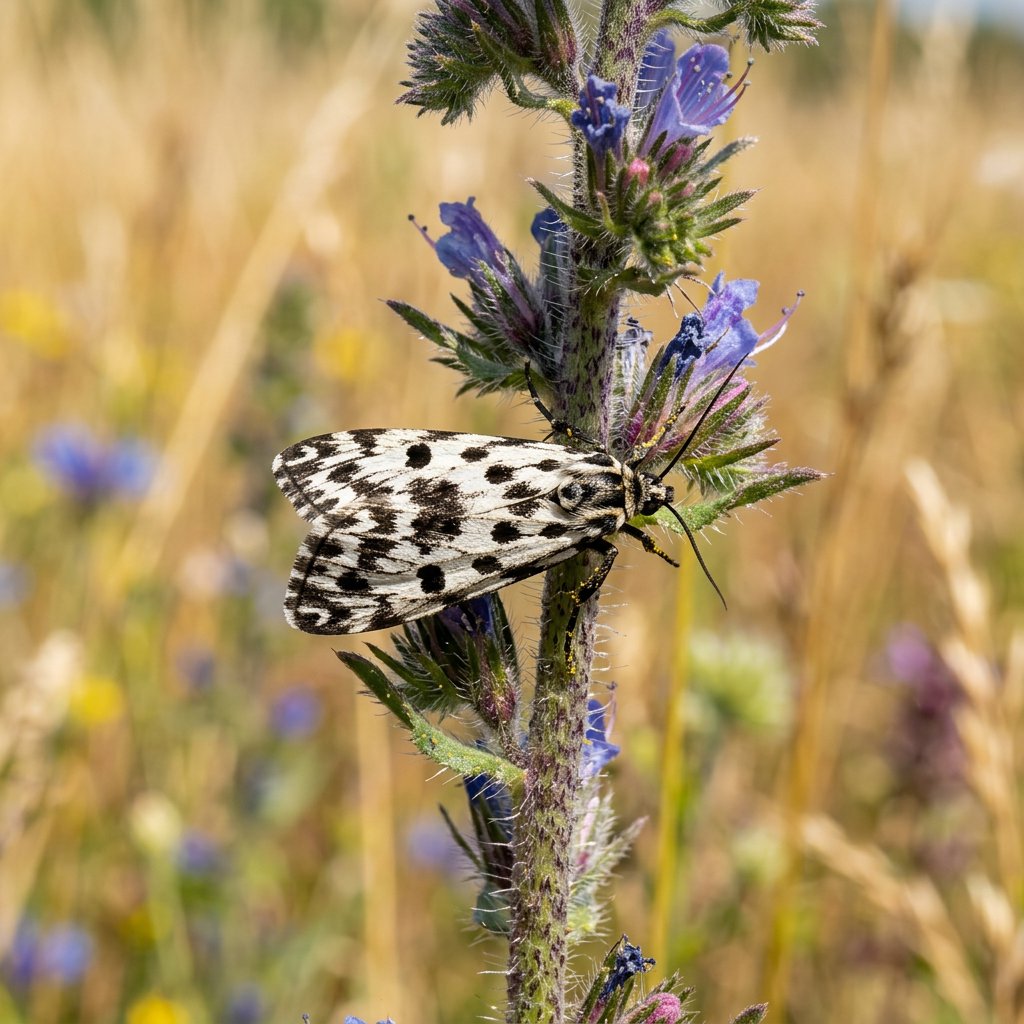
Often known as the Viper’s Bugloss Moth, this striking little insect is a monochrome masterpiece of the meadows. While many moths are dull brown, Ethmia bipunctella sports a high-contrast "polka-dot" look that makes it look like it was designed for a fashion runway. It is a harmless friend to gardeners, serving as a specialized pollinator that spends its entire life cycle tied to one specific, beautiful wildflower.
🔍 How to Identify
- ⚪ The Wings: The forewings are a clean, crisp white on the upper half and a smoky grey-black on the lower half, decorated with distinct black dots.
- 📏 The Silhouette: When resting, it holds its wings in a tight, roof-like shape over its body, often looking like a tiny, elongated seed or a bit of bird lime to confuse predators.
- 🎨 The Larva: The caterpillar is just as stylish, featuring bright yellow and grey stripes with black spotting, making it easy to spot against green foliage.
🌲 Habitat & Ecology
- 🌸 The Host Plant: This moth is a specialist; its life revolves almost entirely around Echium vulgare (Viper’s Bugloss). If you have this plant in your garden, you are likely to see these moths nearby.
- 🌙 Night Moves: While they are primarily nocturnal and are frequently seen circling porch lights, they are often found resting head-down on plant stems during the day, perfectly camouflaged against the shadows.
- 🕸️ Social Spinners: The caterpillars live in a light, silken web they spin over the leaves of their host plant, which protects them from predators while they feast.
⚠️ Safety & Toxicity
- ✅ Harmless: This moth is completely safe. It does not bite, sting, or carry any diseases.
- 🐶 Pet Friendly: It is non-toxic to cats and dogs. In fact, it’s a high-protein snack for garden birds and bats!
- 🌿 Plant Impact: While the larvae eat leaves, they rarely do enough damage to kill the plant, and the adult moths help with pollination.
✨ Fun Fact
Despite its name bipunctella (which means "two-spotted"), this moth actually has many more than two spots! The name was given by early naturalists who were looking at the distinct pairs of dots on the thorax rather than the entire wing pattern.
More Details








