Info
Known as the "Japanese Land Snail," the Euhadra is a genus of large, air-breathing mollusks native to the islands of Japan. Though sometimes mistaken for common garden "bugs," these snails are actually sophisticated forest dwellers with deep roots in Japanese nature lore, often appearing in art and poetry as symbols of patience and the changing seasons.
🔍 How to Identify
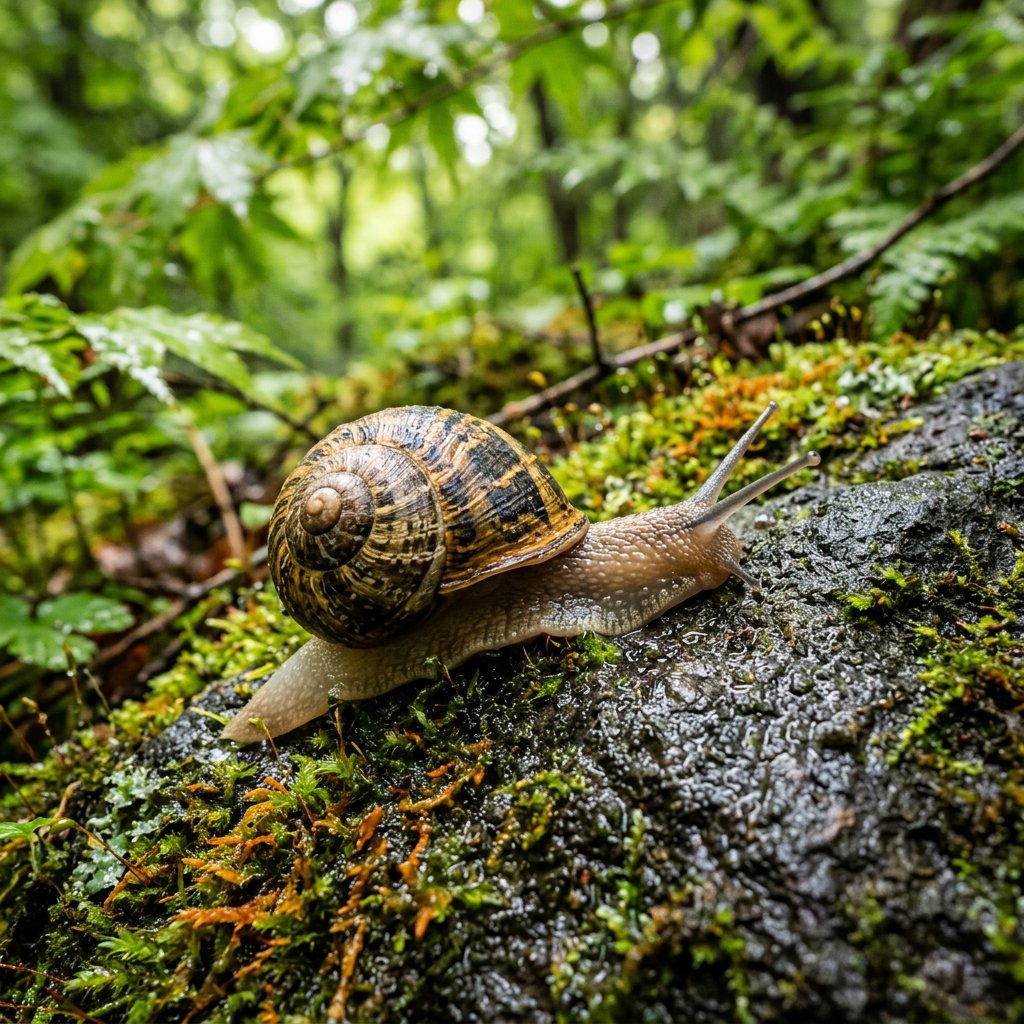
- 🐚 The Shell: These snails possess a large, sturdy, and slightly flattened spiral shell. Colors range from pale cream to rich mahogany, often decorated with one or more dark brown bands.
- 🌀 The "Handedness": A fascinating trait of Euhadra is their coil direction. Some species are "dextral" (right-handed/clockwise), while others are "sinistral" (left-handed/counter-clockwise).
- 🐌 The Body: They have a broad, muscular "foot" used for gliding and two pairs of retractable tentacles; the longer upper pair holds the eyes.
🌲 Habitat & Ecology
- 🍂 Woodland Recyclers: Primarily found in humid forests and lush gardens, they spend their days tucked under leaf litter or scaling trees. They play a vital role in the ecosystem by breaking down decaying plant matter.
- 💧 Moisture Seekers: They are most active during the "Tsuyu" (rainy season) in Japan. When it gets too dry, they retreat into their shells and seal the opening with a layer of dried mucus to stay hydrated.
⚠️ Safety & Toxicity
- 🟢 Harmless to Touch: Euhadra snails are non-aggressive and do not bite or sting. They are safe for curious nature lovers to observe up close.
- 🧼 Wash Your Hands: While not toxic, all wild snails can carry microscopic parasites (like lungworm) on their slime. Always wash your hands thoroughly after handling them, and never ingest them.
✨ Fun Fact
Evolutionary scientists love Euhadra because their "handedness" creates a biological barrier; a "right-handed" snail usually cannot mate with a "left-handed" snail because their reproductive organs won't line up! This quirk can lead to the accidental birth of entirely new species.
More Details








