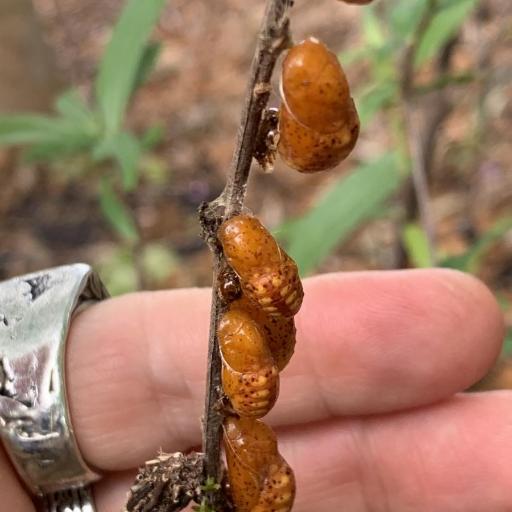
Info
The Atala Butterfly (or simply the "Atala") is one of nature’s most stunning "comeback kids." Once thought to be extinct in the mid-20th century due to the over-harvesting of its host plant, this iridescent jewel was rediscovered in 1979 and has since become a symbol of conservation success. With its velvety black wings and neon-orange abdomen, it looks more like a piece of flying jewelry than a typical garden insect.
🔍 How to Identify
- 🦋 The Wings: Deep velvety black with rows of shimmering, iridescent turquoise-blue spots along the edges of the hindwings.
- 🧡 The Abdomen: A strikingly bright, neon-orange abdomen that remains visible even when the butterfly is at rest.
- 🐛 The Caterpillar: Unlike many green larvae, Atala caterpillars are bright reddish-maroon with two rows of distinct yellow spots, signaling to predators that they are highly toxic.
🌿 Habitat & Ecology
- 🌱 Specialist Eater: This butterfly is a specialist, meaning it relies almost entirely on the Coontie plant (Zamia integrifolia), an ancient Florida cycad. Without Coontie, the Atala cannot complete its life cycle.
- 🛑 Confidence in Flight: Because the Atala is chemically protected by toxins it absorbs from its host plant, it doesn't bother with fast, erratic flight. It flutters slowly and gracefully, confident that birds and lizards will avoid it after one bad taste.
- 🏡 Garden Role: While they are beautiful pollinators, a large group of Atala caterpillars can quickly "skeletonize" a Coontie plant. Don't panic—the plant usually recovers, and you’re witnessing a rare conservation success in your own backyard!
⚠️ Safety & Toxicity
- 🚫 Non-Aggressive: The Atala butterfly does not bite or sting. It is perfectly safe to observe closely.
- 🤢 Toxic if Ingested: Both the larvae and the adults contain cycasin, a potent toxin. While they aren't a threat to touch, they are dangerous if eaten by pets (dogs or cats) or curious children.
- 🧴 Skin Irritation: Some people with sensitive skin may experience mild irritation if they handle the caterpillars directly; it is always best to observe these beauties with your eyes, not your hands.
✨ Fun Fact
The Atala’s survival is largely thanks to a single colony found on a barrier island in Miami in 1979. Every Atala butterfly you see today in Florida is likely a descendant of that one small, lucky group!
More Details








