Info
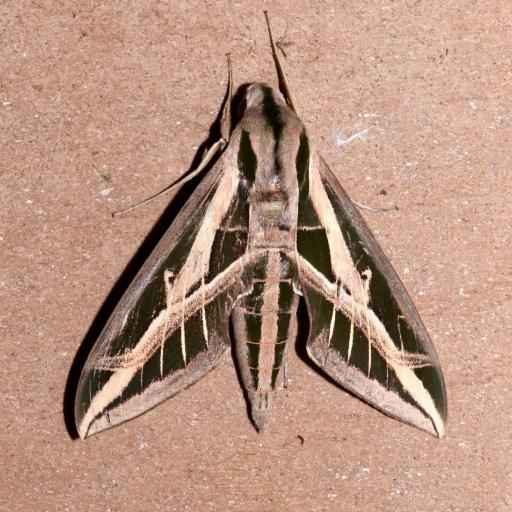
Often mistaken for a tiny bird darting through the twilight, the Banded Sphinx Moth (Eumorpha fasciatus) is a master of precision flight and geometric beauty. While it is frequently found hovering around garden flowers, it is an insect, not a plant, though it relies heavily on specific "host plants" for its survival. Its scientific name translates perfectly to its appearance: "well-formed" and "banded."
🔍 How to Identify
- 🦋 Architectural Wings: The forewings feature a stunning mosaic of deep olive green and chocolate brown, intersected by sharp, cream-colored diagonal stripes that look like a hand-painted tapestry.
- 🌸 Hidden Pink Flash: When it takes flight, it reveals a secret: a vibrant splash of rosy pink on its hindwings that acts as a "startle" defense against predators.
- 🚀 Aerodynamic Body: It possesses a thick, torpedo-shaped body that tapers to a point, allowing it to cut through the air with incredible speed and stability.
🌲 Habitat & Ecology
- 🌙 The Night Shift: As a crepuscular and nocturnal species, you’ll most likely spot them at dusk. They are famous for "hovering" in front of flowers just like a hummingbird, using a long proboscis to sip nectar.
- 🌿 Primrose Lovers: In its caterpillar stage, this moth is a large, multicolored "hornworm." It lives almost exclusively on Water Primrose (Ludwigia) and Evening Primrose, where it can blend in perfectly with the stems and leaves.
⚠️ Safety & Toxicity
- 🛡️ Harmless Visitor: Despite their large size and fast, buzzing flight, Banded Sphinx Moths are completely harmless. They do not have a stinger and their mouthparts are designed only for drinking nectar.
- 🐾 Pet & Human Safe: They are non-toxic to humans and curious pets. The "horn" on the tail of the caterpillar is actually a soft fleshy nub and cannot poke or venomously scratch.
✨ Fun Fact
Sphinx moths are the fighter jets of the insect world; some species have been clocked flying at speeds of over 12 miles per hour, making them some of the fastest-flying insects on the planet!
More Details








