Info
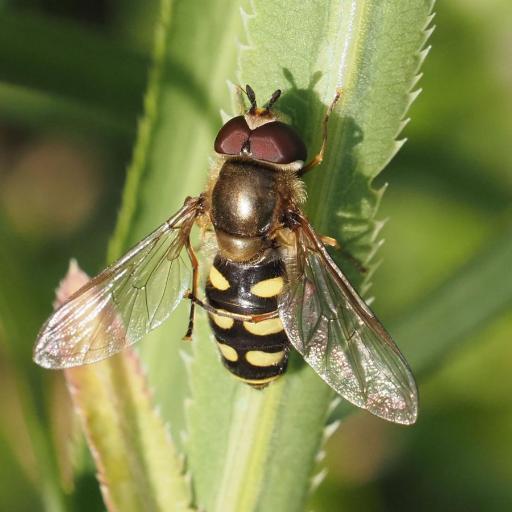
Meet the Glass-winged Hoverfly, a master of disguise and a tireless guardian of your garden. Often mistaken for a small wasp due to its bold yellow stripes, this little aeronaut is actually a harmless fly that prefers flowers over fights. Its name, luniger, refers to the moon-shaped markings on its back, adding a touch of celestial mystery to this common garden visitor.
🔍 How to Identify
- 👀 Large Fly Eyes: Unlike wasps, they have massive, wrap-around eyes that take up most of their head. In males, the eyes actually touch at the top.
- 🌙 The "Lunules": Look closely at the yellow bands on its black abdomen; they are curved like tiny crescent moons and typically do not reach the very edge of the body.
- 🚁 Stationary Flight: They are famous for their namesake ability to "hover" perfectly still in mid-air before darting away at high speeds—a trick real wasps can't pull off.
🌲 Habitat & Ecology
- 🌿 The Aphid Assassin: While the adults are peaceful nectar-sippers, their larvae are tiny, legless "slugs" that are voracious predators. They can devour hundreds of aphids, making them one of the best natural pest controllers for your roses.
- 🛫 A Great Migrant: These aren't just local residents; they are world travelers. They are known to migrate in massive numbers across mountain ranges and even seas to find better breeding grounds.
- 🌼 Generalist Pollinator: You will find them in almost any environment with flowers, from urban window boxes to wild meadows and agricultural fields.
⚠️ Safety & Toxicity
- 🛡️ Harmless Mimic: This insect is a "wolf in sheep’s clothing"—or rather, a fly in wasp’s clothing. It has no stinger and no venom. It uses "Batesian mimicry" to trick birds into thinking it's a dangerous wasp.
- 🐾 Pet & Child Safe: They are completely safe to handle (though they are very fast!). They do not bite and pose no threat to curious cats, dogs, or children.
✨ Fun Fact
Hoverflies are such efficient navigators that they can stay perfectly still in high winds by adjusting their wing beats hundreds of times per second, a feat that has inspired drone engineers!
More Details








