Info
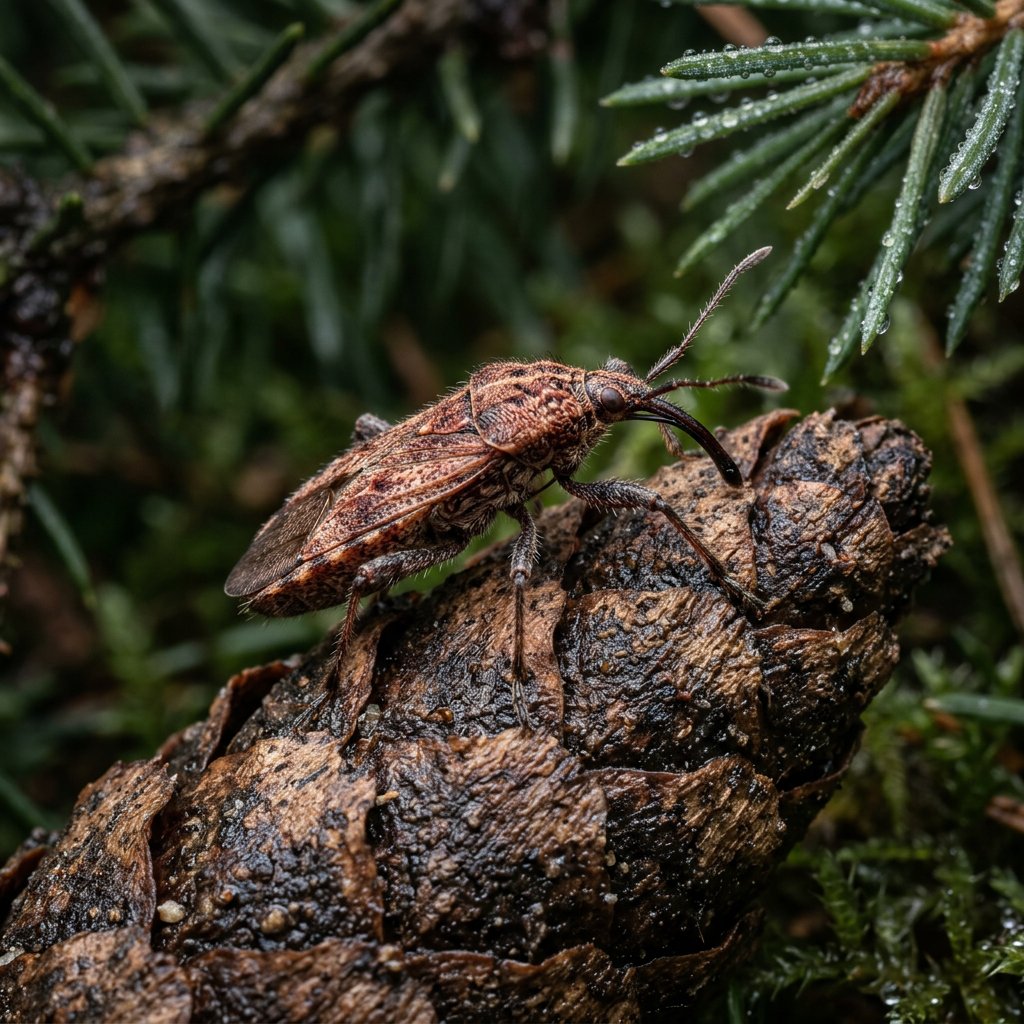
Meet the "Pine Cone Bug," a master of disguise and a specialist of the high canopy. Often mistaken for a common beetle at first glance, this flat-bodied true bug spends its life tucked away within the protective scales of conifer cones. While its scientific name sounds heavy, its lifestyle is surprisingly cozy, revolving entirely around the seeds of evergreen trees.
🔍 How to Identify
- 🪟 Flat Silhouette: Its body is exceptionally thin and flattened—an evolutionary "pancake" design perfect for sliding into the narrow gaps of pine and spruce cones.
- 🍫 Rich Coloring: It typically displays a deep chestnut or mahogany brown hue, allowing it to blend in perfectly with woody debris and dried forest bark.
- 💪 Thickened Forelegs: A key giveaway is its front legs; the upper parts (femora) are notably thickened and muscular, which helps the bug anchor itself and navigate tight spaces.
🌲 Habitat & Ecology
- 🌲 The Conifer Connection: This bug is a specialist that relies almost exclusively on Scots Pine and Spruce. It uses its needle-like mouthparts to suck the nutritious juices from developing seeds.
- 🏠 Cone Hotels: During the autumn and winter, these bugs descend to the forest floor or stay in old cones. It is common to find several individuals huddled together inside a single fallen cone, using it as a "hotel" to survive the winter frost.
- ✈️ High-Altitude Life: In the spring, they fly back up into the treetops to mate and lay eggs, ensuring the next generation is born right next to their favorite food source.
⚠️ Safety & Toxicity
- 🛡️ Completely Harmless: The Pine Cone Bug is a gentle forest dweller. It does not possess a stinger, and it lacks the mouthparts required to bite humans or pets.
- 🌿 Garden Neutral: While they feed on seeds, they are rarely found in high enough numbers to damage ornamental garden trees. They are considered a natural part of the forest ecosystem rather than a pest.
✨ Fun Fact
✨ Pancake Power: Because they are so incredibly thin, these bugs can hide in crevices that are only a few millimeters wide. This "extreme flatness" makes them nearly invisible to hungry birds looking for a snack during the winter months!
More Details








