Info
Often called the Dor Beetle or the "Lousy Watchman," the Geotrupes stercorarius is one of nature’s most industrious sanitation workers. While its heavy, armored body and loud, low-pitched buzzing flight might startle you on a summer evening, this beetle is a gentle giant of the insect world. In folklore, its appearance was often seen as a weather omen—the higher it flew, the finer the next day’s weather would be.
🔍 How to Identify
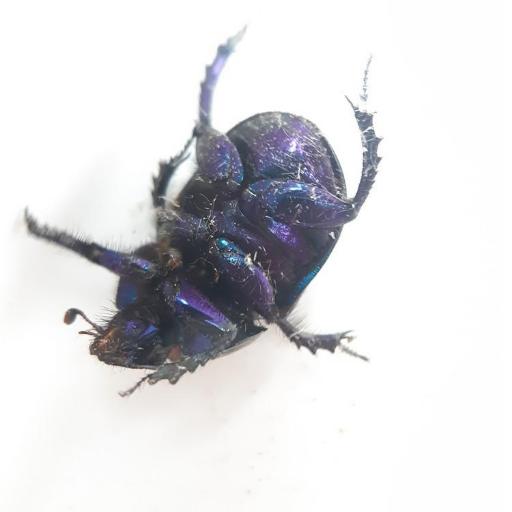
- 🪖 The Exoskeleton: A robust, oval-shaped body that appears solid black from above, but reveals a stunning metallic violet, blue, or green shimmer on its underside.
- ⛏️ The Diggers: Powerful, spiny legs specifically adapted for heavy-duty excavation, resembling miniature serrated shovels.
- 📡 The Antennae: Short, clubbed antennae that end in three leaf-like plates, which it uses to "sniff out" food from great distances.
🌲 Habitat & Ecology
- 💩 The Diet: These beetles are specialized "coprophages," meaning they feed primarily on the dung of herbivores like cattle and horses. By burying waste, they recycle nutrients back into the soil.
- 🏗️ Master Tunnelers: Beneath a pile of dung, the female digs impressive vertical shafts that can reach up to 20 inches (50 cm) deep, creating "brood chambers" for her eggs.
- 🚜 Soil Aerators: Their constant digging acts as a natural tilling service, improving soil structure and helping water reach plant roots more effectively.
⚠️ Safety & Toxicity
- 🛡️ Status: Completely harmless to humans and pets. They possess no stinger and are not aggressive.
- 🤏 The "Bite": While they have mandibles to move food, they are very unlikely to bite a human. If handled, they might feel "scratchy" due to their spiny legs, but they cannot break the skin.
- 🕷️ Hitchhikers: You may often see tiny orange mites clinging to their underside. Don't worry—these are "phoretic" mites that simply use the beetle as a bus to travel from one food source to another!
✨ Fun Fact
The nickname "Lousy Watchman" comes from the fact that these beetles are almost always covered in the aforementioned mites. Ancient observers thought the beetle was "lousy" (infested with lice) while it "watched" over the fields at night.
More Details








