Info
Often called the "Primitive Wasps," the Gilpinia genus belongs to the sawfly family, though they aren't true flies at all. These stout-bodied insects are famous (or infamous) for their deep connection to evergreen forests, where their larvae blend perfectly with the needles they call home. While they may look like wasps to the untrained eye, they are gentle herbivores that lack the ability to sting.
🔍 How to Identify
- 🐝 Broad Waist: Unlike common wasps or bees, Gilpinia adults lack a "wasp waist"; their thorax and abdomen are broadly joined, giving them a more rectangular, sturdy appearance.
- 🪚 The "Saw" Ovipositor: Females possess a specialized, microscopic saw-like organ used to cut tiny slits into pine or spruce needles to tuck their eggs safely inside.
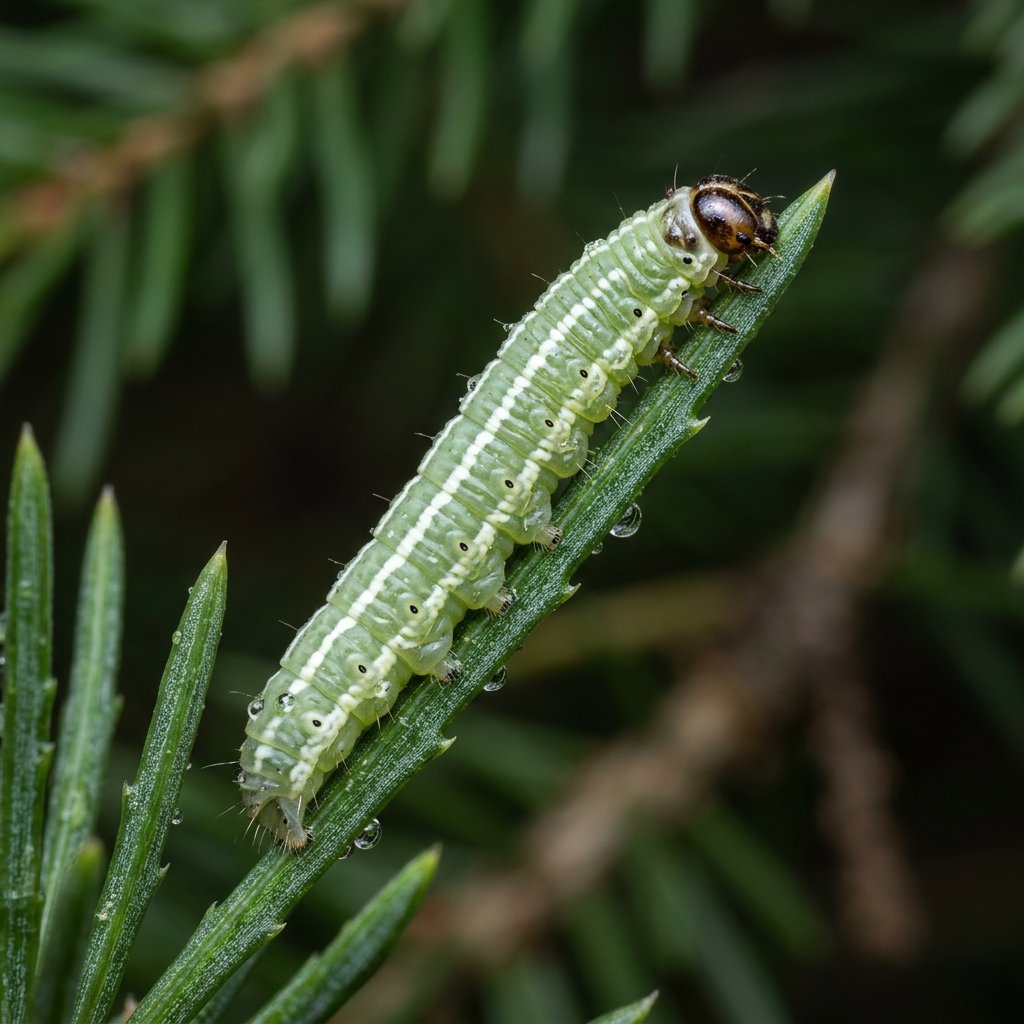
- 🐛 Larval Camouflage: The larvae look remarkably like caterpillars but have more than five pairs of prolegs; they are usually lime green with subtle stripes, mimicking the texture of conifer needles.
🌲 Habitat & Ecology
- 🌲 Conifer Specialists: You will almost exclusively find these insects near spruce, pine, or fir trees. They are considered "specialists," meaning they rely entirely on these specific trees for their lifecycle.
- 🍃 Master Defoliators: In the larval stage, they are voracious eaters. They start at the tips of needles and eat their way down, which can sometimes cause "thinning" in the canopy of ornamental garden evergreens.
⚠️ Safety & Toxicity
- ✅ Human Safety: Gilpinia sawflies are completely harmless to humans and pets. They do not have a stinger and are not aggressive, even if handled.
- 🌳 Plant Health: While safe for you, they are a "foe" to your trees. A large population can stress a spruce tree by removing its ability to photosynthesize, making the tree vulnerable to secondary diseases.
✨ Fun Fact
Many species within the Gilpinia genus are capable of "parthenogenesis." This means females can produce offspring without ever mating with a male, allowing a single traveler to start an entire colony on a new tree!
More Details








