Info
Known widely as the Horse Leech, this impressive annelid is frequently the victim of a bad reputation. Despite its intimidating size and "vampiric" name, it is not actually a blood-sucker of mammals. Instead, it is a robust predator and scavenger that plays a vital role in cleaning up pond ecosystems by hunting smaller invertebrates.
🔍 How to Identify
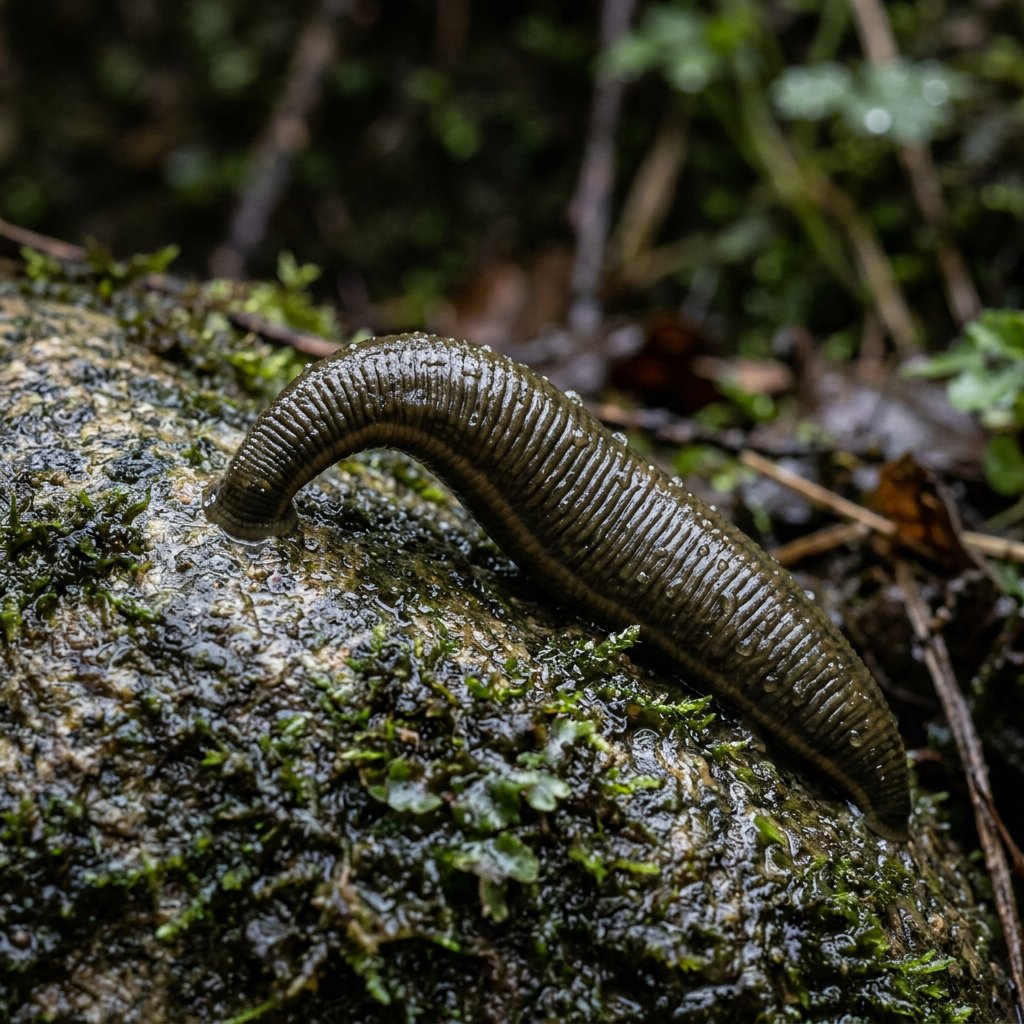
- 🐍 Body Shape: It features a long, muscular, and somewhat flattened body that can stretch out to nearly 15 centimeters when moving, but bunches up into a thick, firm cylinder when disturbed.
- 🌑 Coloration: The upperside is typically a dark olive-green or brownish-black, while the belly is usually a contrasting dull yellow or orange, sometimes with dark spots.
- 🌀 Texture: Unlike earthworms, its body is incredibly smooth and lacks bristles. It has two suckers—one at the head and a larger, more powerful one at the tail used for anchoring.
🌲 Habitat & Ecology
- 💧 The Water’s Edge: You’ll most often find them in the "marginal zone" of ponds, ditches, and slow-moving streams. They are semi-aquatic and frequently crawl out of the water into damp mud or under large stones to hide during the day.
- 🍴 Predatory Diet: It is a fierce hunter of the miniature world. It does not suck blood; instead, it uses its powerful mouth to swallow small snails, midge larvae, and even entire earthworms whole.
- 🚶 Locomotion: In the water, it swims with an elegant, ribbon-like undulating motion. On land, it moves like an "inchworm," using its suckers to loop its body forward.
⚠️ Safety & Toxicity
- 🟢 Status: Completely harmless to humans and large animals.
- 🦷 No Bite: The Horse Leech lacks the sharp, sawing teeth of the Medicinal Leech. Its jaws are far too weak to pierce human skin or the hides of livestock, so there is no risk of it "latching on" to you for a meal.
- 🐾 Pets: It poses no danger to dogs or cats that enjoy a swim. If one sticks to your pet, it is likely just using them as a temporary resting spot and will not cause any injury or irritation.
✨ Fun Fact
🧪 Mistaken Identity: Its name, Sanguisuga, literally means "blood-sucker," reflecting a centuries-old mistake by early naturalists who assumed all large leeches shared the same diet. In reality, a Horse Leech would be much more interested in eating a garden worm than bothering a horse!
More Details








