Info
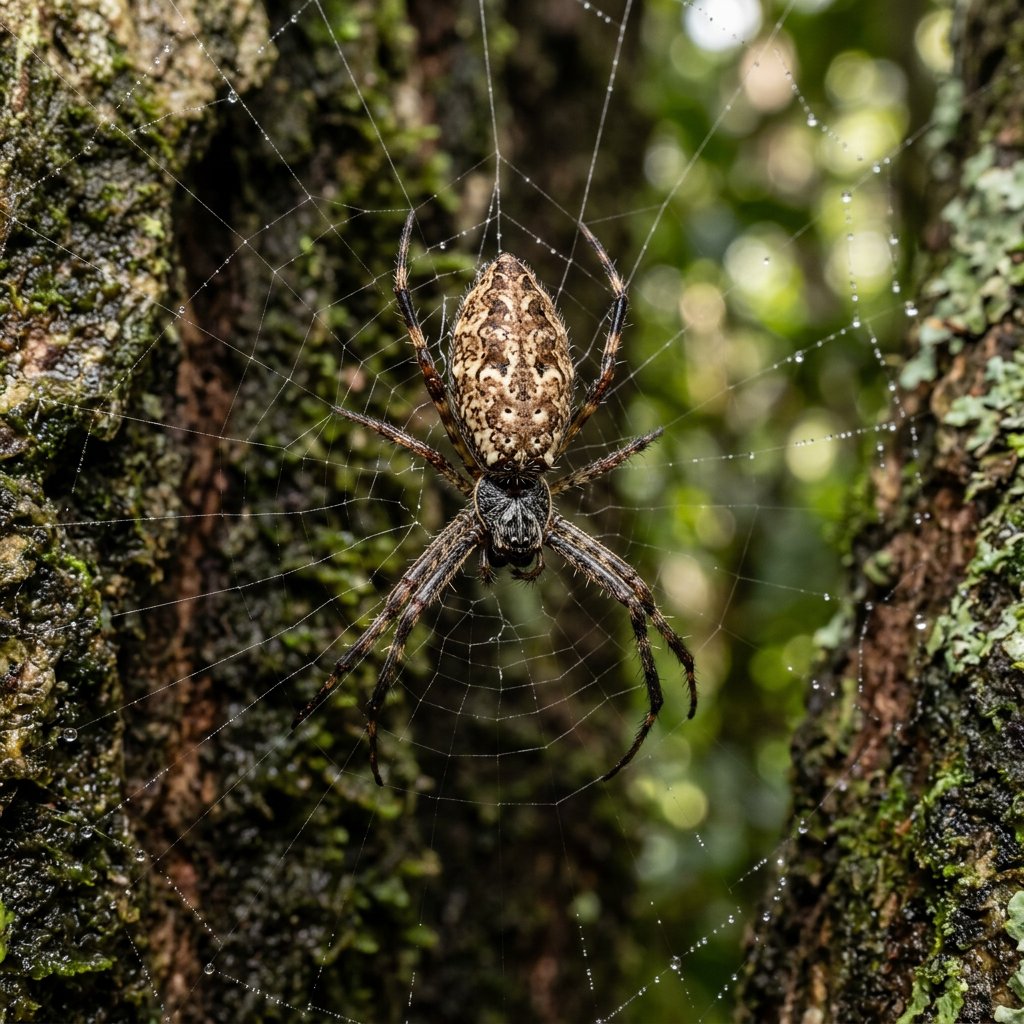
Often called the Multi-spotted Ornament Spider or the Bronzed Coin Spider, this arachnid is a true masterpiece of natural camouflage. Found throughout tropical Asia, it looks less like a living creature and more like a piece of hammered metal or a decorative brooch pinned to a tree. While its flattened shape might look intimidating, it is a peaceful "friend" of the garden that specializes in catching bark-dwelling pests.
🔍 How to Identify
- 🎨 Flattened Abdomen: The body is remarkably thin and disc-like, featuring a "scalloped" edge and a series of dark, symmetrical pits (sigilla) that look like tiny punctures.
- 🛡️ Metallic Sheen: Their coloration usually consists of bronzed, silvery, or grayish tones that perfectly mimic the lichen and moss found on tree trunks.
- 🕷️ Lateral Leg Span: Unlike many spiders that hold their legs in an "X" or "O" shape, the Ornament Spider spreads its legs out flat to the sides, allowing it to hug the bark without casting a shadow.
🌲 Habitat & Ecology
- 🌳 The Bark Dweller: This spider is almost exclusively found on the trunks of large trees. It rarely wanders into homes, preferring the vertical "highways" of the forest or older garden trees.
- 🕸️ Modified Orb Web: Instead of spinning a classic circular web in mid-air, it creates a "ladder web"—a long, narrow strip of silk pressed tight against the tree bark to catch insects crawling up or down the trunk.
- 🦗 Pest Controller: They are excellent at managing populations of ants, moths, and wood-boring beetles that move along the surface of the tree.
⚠️ Safety & Toxicity
- 🛡️ Harmless Ally: They are not aggressive and have no interest in humans. Their first instinct when threatened is to press themselves even flatter against the bark to "disappear."
- 🐾 Low Risk: While they do possess venom (like almost all spiders) to neutralize their insect prey, it is not considered medically significant to humans or pets. A bite would be comparable to a mild bee sting and is extremely rare.
✨ Fun Fact
The Multi-spotted Ornament Spider is so committed to its camouflage that even its egg sacs are flattened and disguised with bits of debris and silk to look like a natural knot or bump in the tree's bark!
More Details








