Info
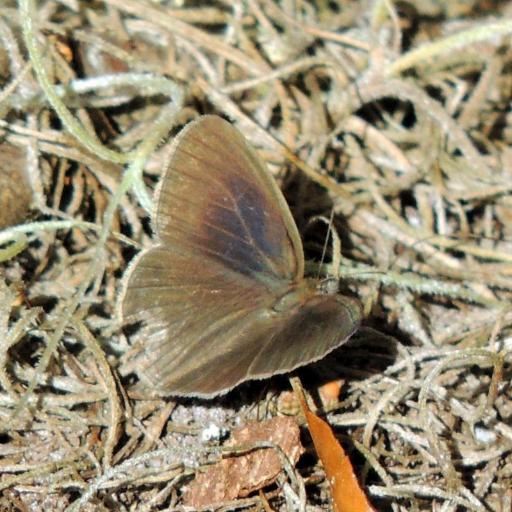
Often overlooked because of its modest brown coloring, the Hermes Satyr is a master of camouflage in the undergrowth. Named after the Greek messenger god, this little butterfly flits low through the grass, using a series of "many eyes" on its wings to confuse and redirect predators. It is a staple of the Southern United States and the Neotropics, acting as a quiet, essential part of the local meadow ecosystem.
🔍 How to Identify
- 🦋 Wing Color: The wings are a subtle, earthy grayish-brown, designed to mimic a dead leaf when the butterfly rests with its wings closed.
- 👁️ The Eyespots: The underside of the wings features a row of small, distinct black "ocelli" (eyespots) ringed in bright yellow, which serve to trick birds into pecking at the wing edges rather than the insect's head.
- 📏 Flight Style: It has a low, bobbing, and somewhat erratic flight pattern, rarely rising more than a few feet above the grass or forest floor.
🌲 Habitat & Ecology
- 🍃 Dietary Quirks: Unlike many showy butterflies that nectar exclusively on flowers, the Hermes Satyr often prefers sipping on fermenting fruit, tree sap, or even nutrient-rich damp earth.
- 🏡 The Grass Dweller: You are most likely to find them in "edge" habitats—where the lawn meets the woods or near damp, shaded ditches—where their larvae can feed on various species of grasses.
⚠️ Safety & Toxicity
- ✅ Harmless Nature: The Hermes Satyr is a "friend" to the gardener. It has no sting, does not bite, and does not possess any chemical defenses that make it toxic.
- 🐾 Pet & Child Safe: Because they do not feed on toxic plants (like Milkweed), they are safe for pets and children to observe closely. They are delicate, so the only "danger" is to the butterfly itself if handled roughly.
✨ Fun Fact
For nearly a century, butterfly enthusiasts struggled to tell the Hermes Satyr apart from its nearly identical cousin, the Carolina Satyr. It wasn't until scientists looked at the microscopic patterns of their wing veins that they realized they were looking at two different species!
More Details








