Info
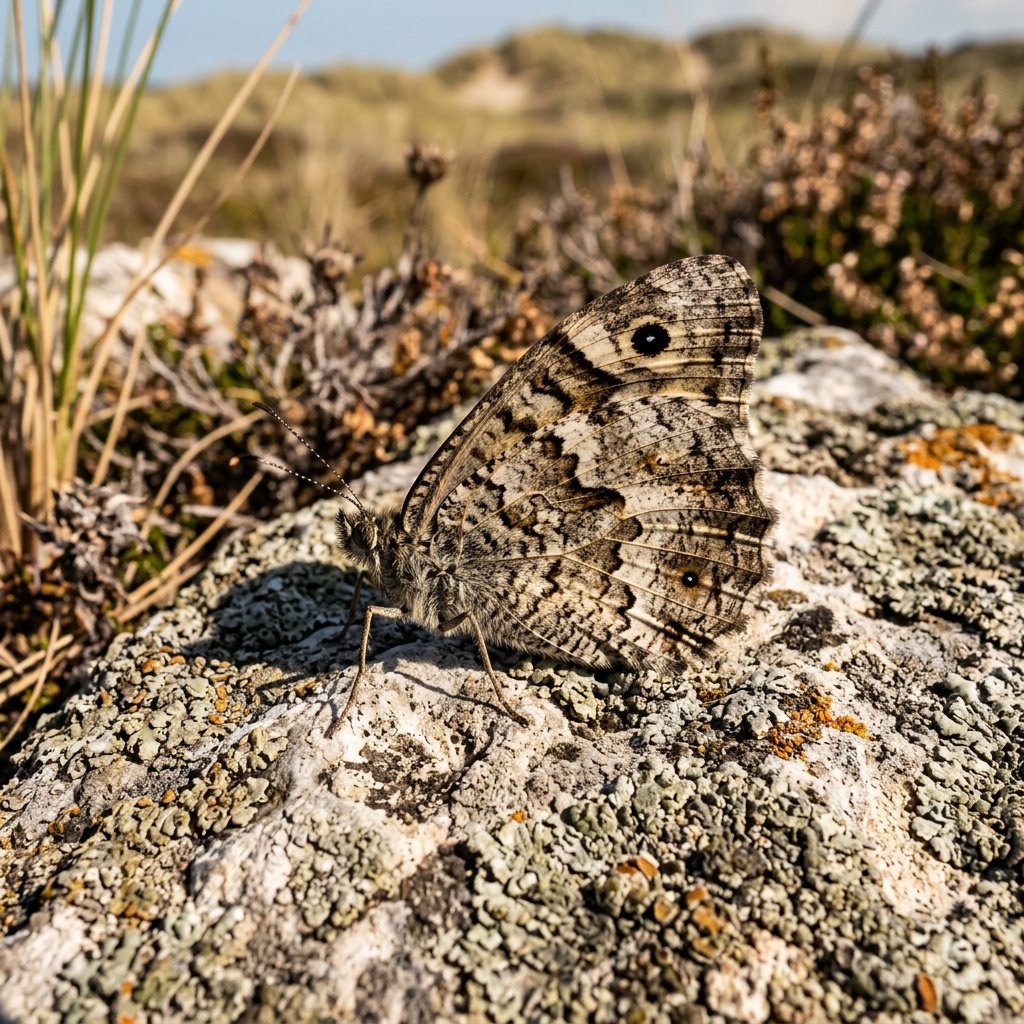
Often called the "Master of Disguise," the Grayling (Hipparchia semele) is a butterfly that has perfected the art of vanishing. Found across Europe and parts of North Africa, it is the undisputed champion of camouflage, frequently disappearing against the backdrop of stone or bark the moment it lands. While it may look like a simple brown moth at a distance, its clever behavior and subtle markings make it a favorite among naturalists.
🔍 How to Identify
- 🦋 The Underside: The underside of the hindwings is a complex, marbled pattern of grey, white, and brown, perfectly mimicking lichen-covered rocks or dry earth.
- 👁️ Hidden Eye-spots: The forewings feature two large, dark eye-spots surrounded by orange, but these are almost always tucked away behind the hindwings when the butterfly is at rest.
- 📐 The Lean: It has a unique habit of tilting its entire body sideways when it lands. By leaning toward the sun, it minimizes its shadow, making it nearly impossible for predators to spot its silhouette on the ground.
🌲 Habitat & Ecology
- 🏜️ Preferring the Parched: Unlike garden butterflies that love lush flowers, the Grayling prefers "wastelands," coastal dunes, limestone pavements, and sandy heaths where bare ground is plentiful.
- 🍃 Grassland Larvae: The caterpillars are just as cryptic as the adults, feeding on various grasses like Fescue and Marram grass during the night and hiding deep in the base of the plant during the day.
- 🛡️ A Fragile Resident: While widespread, its populations are sensitive to habitat loss. Seeing one in your area is a sign of a well-preserved, rugged natural landscape.
⚠️ Safety & Toxicity
- 🟢 Harmless Friend: The Grayling is entirely safe. It does not bite, sting, or possess any toxins that could harm humans, pets, or livestock.
- 🦋 Handle with Care: Like all butterflies, its wings are covered in microscopic scales that are easily damaged. It is best to admire this "invisible" insect from a distance without touching.
✨ Fun Fact
The Grayling is a "lateral basker." Instead of opening its wings wide to soak up the sun like most butterflies, it keeps them tightly shut and tilts its body to catch the rays, ensuring it stays warm while remaining perfectly camouflaged.
More Details








