Info
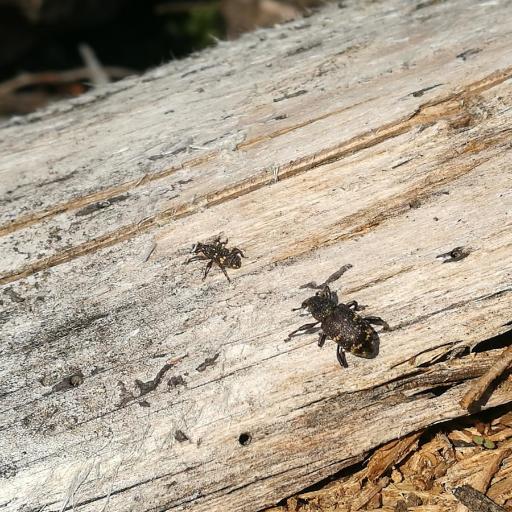
Often called the "Conifer Destroyer," the Large Pine Weevil is a tiny tank of the forest floor. While it looks like a miniature prehistoric creature with its elongated snout, it is most famous—or perhaps infamous—as the primary pest of young reforestation sites across Europe and Asia. For a forester, seeing this weevil is a sign of trouble, but for a nature observer, it is a fascinating example of specialized evolution.
🔍 How to Identify
- 👃 The Snout (Rostrum): Its most striking feature is a long, downward-curving snout. This isn't a stinger; it's a specialized tool for feeding on tough bark.
- 🧥 Textured Armor: The body is a dark, matte brown or black, decorated with irregular patches of golden-yellow hairs that look like flecks of gold dust.
- 📡 Elbowed Antennae: Look closely at the snout—halfway down, you'll see two distinct "L-shaped" or elbowed antennae poking out from the sides.
🌲 Habitat & Ecology
- 🪵 The Stump Specialist: These insects have a clever lifecycle tied to timber harvesting. They lay their eggs in the stumps of freshly felled pine and spruce trees, where the larvae can develop in safety.
- 🍽️ Girdling Behavior: While the larvae stay in the stumps, the adults emerge to feed on the tender bark of young saplings. They often "girdle" the tree (eating a ring of bark around the stem), which can unfortunately kill the young plant.
- 🌙 Nocturnal Wanderer: They are largely nocturnal. During the day, they hide in the cool, damp leaf litter at the base of trees, making them a lucky find for an observant hiker.
⚠️ Safety & Toxicity
- 🛡️ Non-Aggressive: The Large Pine Weevil is completely harmless to humans. It has no interest in biting or stinging you, and it carries no venom.
- 🤏 The "Pinch" Myth: While its legs are grippy and might feel prickly on your skin, its mouthparts are designed for wood, not skin. It is safe to observe closely or gently move if it's in a vulnerable spot.
✨ Fun Fact
🏃 The Long-Distance Hiker: Despite being small and appearing sluggish, these weevils are incredible travelers. They can walk several hundred meters to find a fresh sapling, and if they catch the scent of resin on the wind, they can fly several kilometers to find a new forest!
More Details








