Info
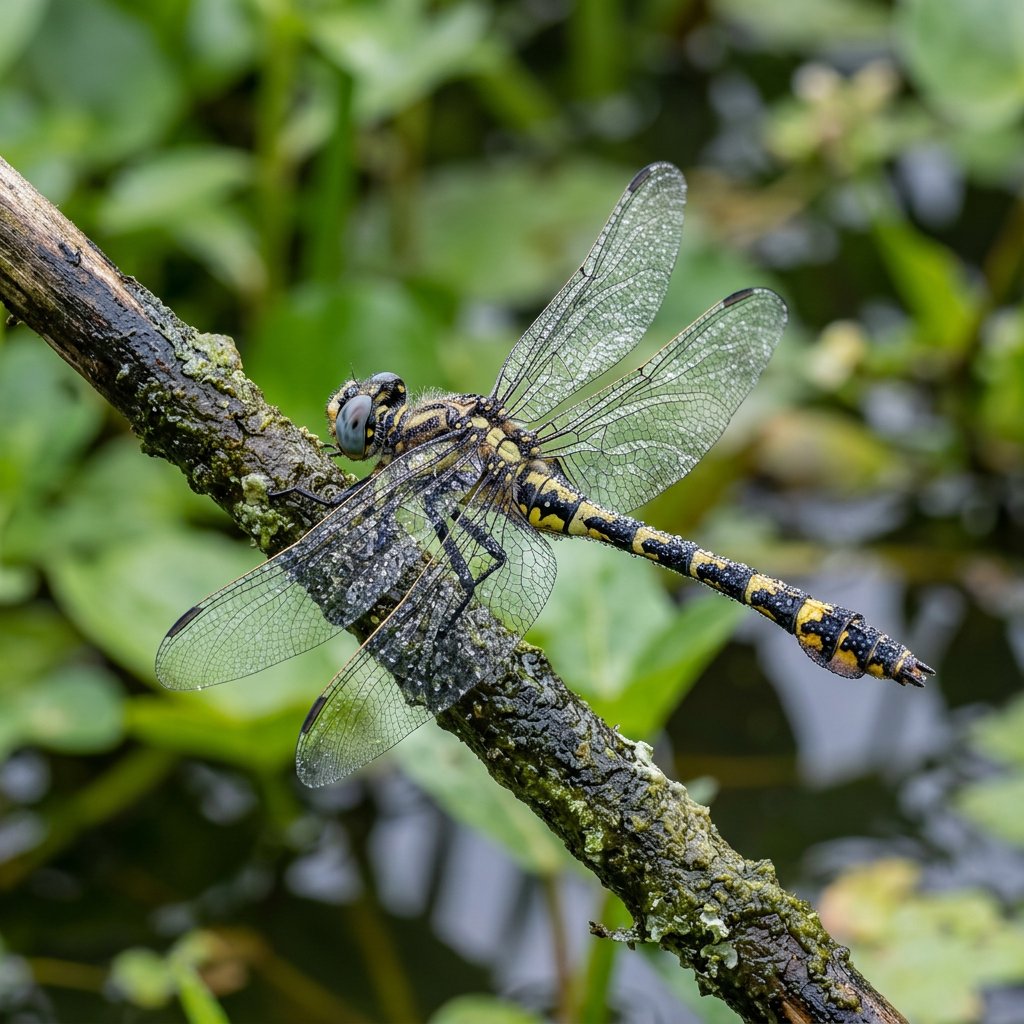
Known as the Common Clubtail, this dragonfly looks like a tiny, winged tiger patrolling the water’s edge. Its striking yellow-and-black patterns and fierce-looking "clubbed" tail make it look intimidating, but it is actually a magnificent aerial acrobat and a master of pest control. Often found near ponds and slow-moving rivers across Asia, it acts as a high-speed guardian of the garden.
🔍 How to Identify
- 👀 Widely Spaced Eyes: Unlike many other dragonfly families whose eyes touch at the top of the head, the Common Clubtail has eyes that are clearly separated.
- 🐅 Tiger Stripes: The body is marked with bold, alternating black and bright yellow or lime-green stripes, providing excellent camouflage among sun-dappled leaves.
- 🚩 The "Club" Tail: The end of the abdomen (segments 8 and 9) features distinct, leaf-like black flaps that give the insect its signature "clubbed" silhouette.
🌲 Habitat & Ecology
- 💧 Waterfront Property: They are most commonly spotted perching on bare twigs, stones, or reeds overlooking still or slow-moving water where they hunt and mate.
- ⚔️ The Raptor of the Air: The name rapax means "rapacious" or "predatory." They are voracious hunters that catch mosquitoes, flies, and even smaller dragonflies mid-air with incredible precision.
- 🧘 The Patient Hunter: Unlike "skimmer" dragonflies that fly constantly, the Clubtail is a "percher." It spends long periods sitting motionless, scanning the horizon for its next meal.
⚠️ Safety & Toxicity
- 🛡️ Completely Harmless: Despite the "club" on its tail looking like a potential weapon, this insect has no stinger. It is entirely non-toxic and poses no threat to humans, pets, or children.
- 🦷 Mechanical Pinch: While they are not aggressive, if you catch one and hold it in your hand, it may try to bite with its mandibles. It feels like a tiny, harmless pinch and rarely breaks the skin.
✨ Fun Fact
The "Clubtail" family (Gomphidae) is one of the most ancient lineages of dragonflies. Their ancestors were patrolling the skies long before the first flowering plants ever appeared on Earth!
More Details








