Info
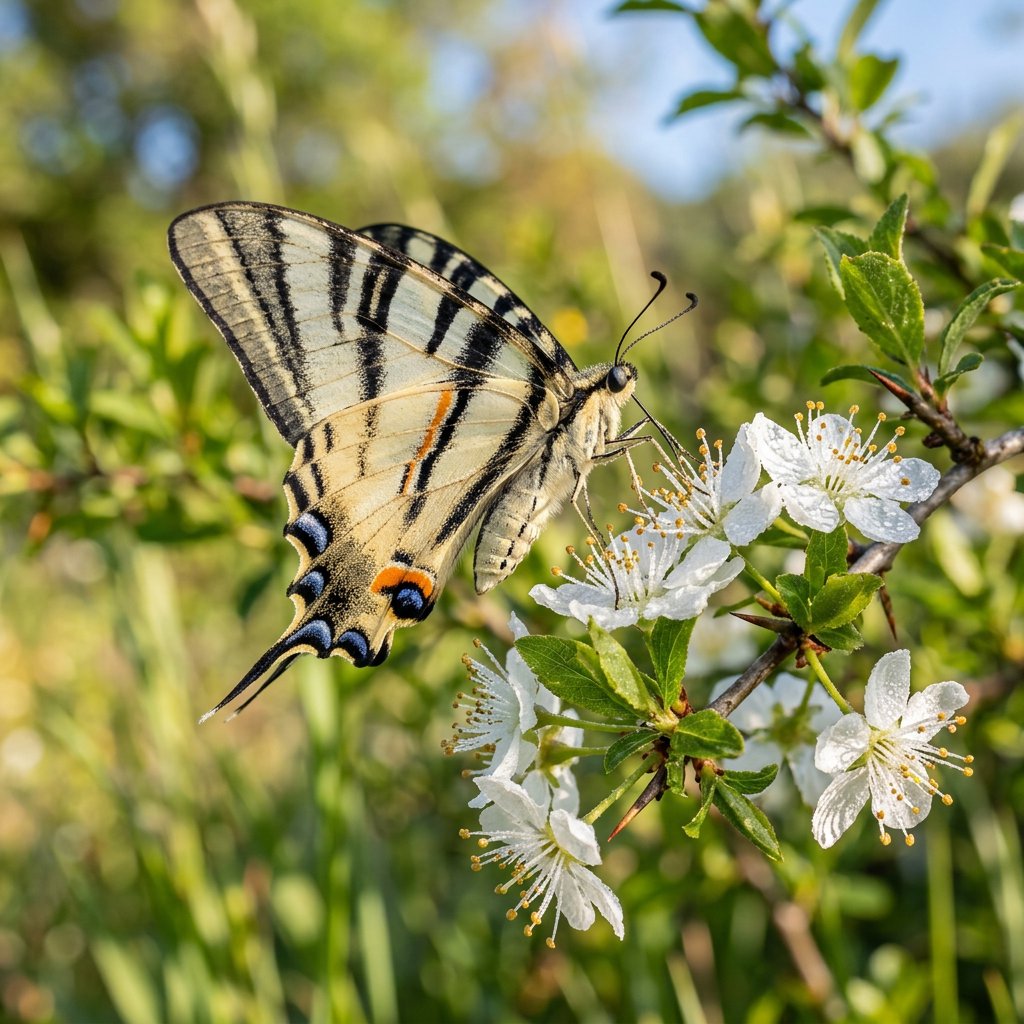
Often called the Scarce Swallowtail or the Sail Swallowtail, this butterfly is one of Europe’s most elegant aerialists. Despite its name, it can be quite common in sun-drenched orchards and gardens, where it floats on the breeze like a miniature kite. In ancient Greek mythology, Podalirius was a healer, fitting for a creature that brings such a sense of calm to any landscape it visits.
🔍 How to Identify
- 🦓 Zebra Stripes: The wings are a creamy white or pale yellow, decorated with striking vertical black "tiger" stripes that taper toward the bottom.
- 🗡️ Elegant Tails: The hindwings feature exceptionally long, thin "tails" that look like delicate streamers or even tiny daggers when the butterfly is at rest.
- 👁️ Target Spots: Near the base of the tails, you’ll find vibrant orange and blue "eyespots" designed to trick predators into attacking the wrong end of the butterfly.
🌲 Habitat & Ecology
- 🍒 The Orchard Lover: Unlike its cousin the Common Swallowtail, this species is deeply tied to fruit trees. Its caterpillars primarily feed on the leaves of Blackthorn, Wild Cherry, and Plum trees.
- ⛵ Sailing Flight: It is famous for a unique "sailing" flight pattern. It can glide for long distances without flapping its wings, using thermal updrafts to patrol its territory or search for a mate.
- 🏰 Hilltopping: Males are often found at the very tops of hills or high garden structures, a behavior called "hilltopping," where they wait for females to fly by.
⚠️ Safety & Toxicity
- 🦋 Harmless Friend: This butterfly is completely safe for humans and pets. It does not sting, bite, or carry any toxins.
- 🌿 Gardener’s Note: While the caterpillars eat the leaves of fruit trees, they rarely appear in large enough numbers to cause any significant damage to your harvest. They are considered a sign of a healthy, pesticide-free ecosystem.
✨ Fun Fact
The Scarce Swallowtail is a master of deception! Those long tails and bright eyespots on the back of its wings are meant to mimic a head. When a bird tries to snap at what it thinks is the butterfly's face, it ends up with a mouthful of wing-tail while the butterfly escapes safely in the opposite direction.
More Details








