Info
Often called the Small Bluetail, this dainty damselfly is a jewel of the wetlands. It is smaller and more delicate than its more common cousins, often appearing as a tiny, shimmering needle darting through the reeds. In the world of insects, it is known as a "pioneer," famous for being the very first species to colonize brand-new ponds or freshly flooded ditches.
🔍 How to Identify
- 💎 Tiny Proportions: It is one of the smallest damselflies in its range, often looking like a thin piece of bright sewing thread hovering in the air.
- 🦋 The Blue "Tail-Light": Males are mostly black, but the end of their abdomen features a bright blue patch. Unlike the Common Bluetail, this blue patch is located on segment 9 and the lower half of segment 8, making it look slightly "shifted" toward the tip.
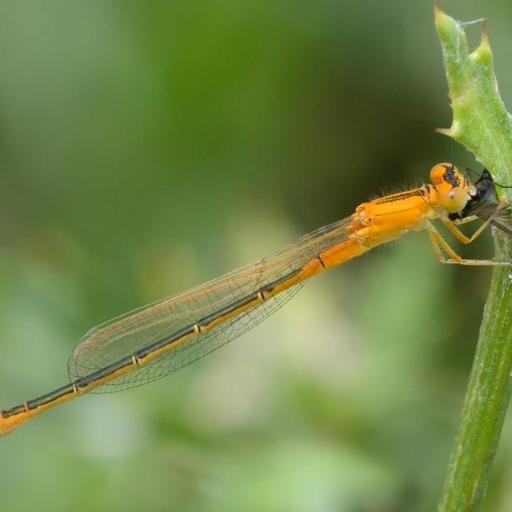
- 🎨 Female Color Magic: Young females (form aurantiaca) are a stunning, vivid neon orange. As they mature, they undergo a dramatic transformation, turning olive green or bronze to better camouflage against the pond-side grass.
🌲 Habitat & Ecology
- 🦟 The Micro-Predator: Don't let their fragile appearance fool you; they are voracious hunters. They spend their days patrolling the water's edge, snatching midges and tiny gnats right out of the air.
- 🏗️ Pioneer Instincts: They specialize in "disturbed" or new habitats. If you dig a new garden pond or a field becomes waterlogged, these are likely the very first dragonflies to move in and claim the territory.
- 🌿 Low-Altitude Lifestyle: Unlike larger dragonflies that soar high, the Small Bluetail stays low. They prefer to skulk among the sedges and grasses, staying out of the wind and away from larger predators.
⚠️ Safety & Toxicity
- ✅ Friend to Humans: The Small Bluetail is completely harmless. They do not possess a stinger, and their mandibles are far too small to bite a human.
- 🐾 Eco-Indicator: Their presence is a great sign! They are safe for pets and children to observe, and they act as a natural pest control by eating mosquitoes and small flies.
✨ Fun Fact
The Small Bluetail is a "fast-track" species. While some dragonflies spend years living underwater as larvae, these clever insects can complete their entire life cycle—from egg to flying adult—in just a few months to take advantage of temporary pools before they dry up!
More Details








