Info
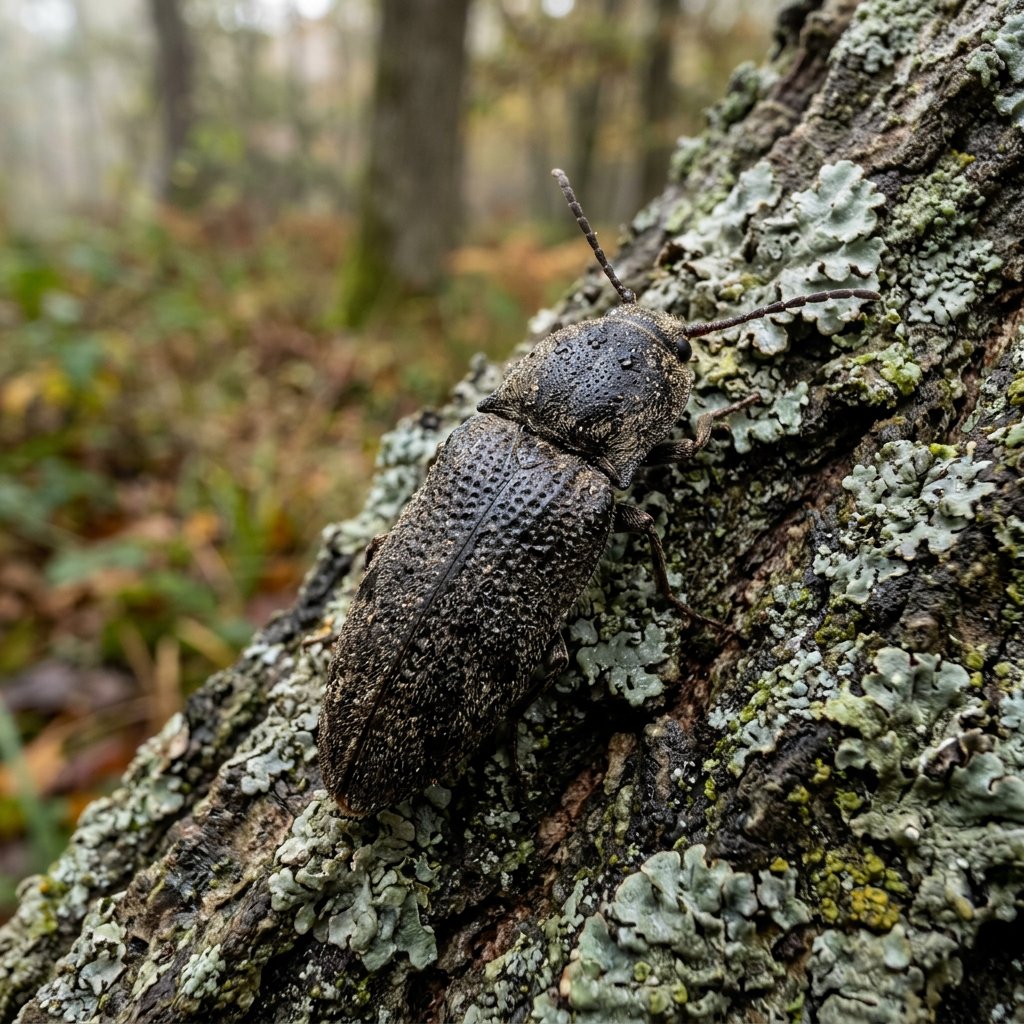
Often called the Grey-speckled Click Beetle, this beetle is a master of camouflage that looks like a weathered piece of charcoal or stone. Found primarily in the ancient forests of Europe and the Mediterranean, it plays a vital role in the woodland ecosystem. While its sudden "clicking" sound might startle you, this beetle is a harmless forest dweller that spends most of its life hidden in the shadows of old trees.
🔍 How to Identify
- 🪲 Mottled Armor: A sturdy, matte-black body covered in tiny, recessed white or greyish scales that give it a "punctured" or dusty appearance.
- 🛡️ Shield-like Shape: It features a large, rounded pronotum (the section behind the head) with distinct, pointed "ears" at the back corners.
- 📏 Robust Size: Larger and wider than many of its click-beetle cousins, often reaching up to 20mm in length with a flattened, aerodynamic profile.
🌲 Habitat & Ecology
- 🪵 The Wood Recycler: This beetle is "saproxylic," meaning it is strictly tied to dead or decaying wood. It is a specialist of old-growth forests, particularly fond of rotting Oak, Pine, and Cedar trees.
- 🏹 Secretive Predator: While adults are sometimes seen on bark or flowers, their larvae (known as wireworms) live deep inside rotten logs. These larvae are fierce predators, hunting the grubs of other wood-boring insects.
- 🌳 Indicator Species: Because it requires very specific types of aging wood, the presence of Lacon punctatus is often a sign of a healthy, mature forest ecosystem.
⚠️ Safety & Toxicity
- ✅ Friendly Giant: This insect is completely harmless to humans. It does not bite, sting, or carry any toxins.
- 🔊 Startle Defense: When flipped on its back or threatened, it uses a specialized "peg" on its underside to snap its body, making a loud click and launching itself into the air. This is a survival tactic to escape birds, not an attack on you!
- 🐾 Pet Safe: It poses no threat to curious cats or dogs, though the hard shell might make it an unappealing snack.
✨ Fun Fact
- 🚀 Extreme G-Force: When a click beetle "clicks" to escape, it can experience an acceleration of up to 400Gs. For context, a human fighter pilot usually blacks out at around 9Gs!
More Details








