Info
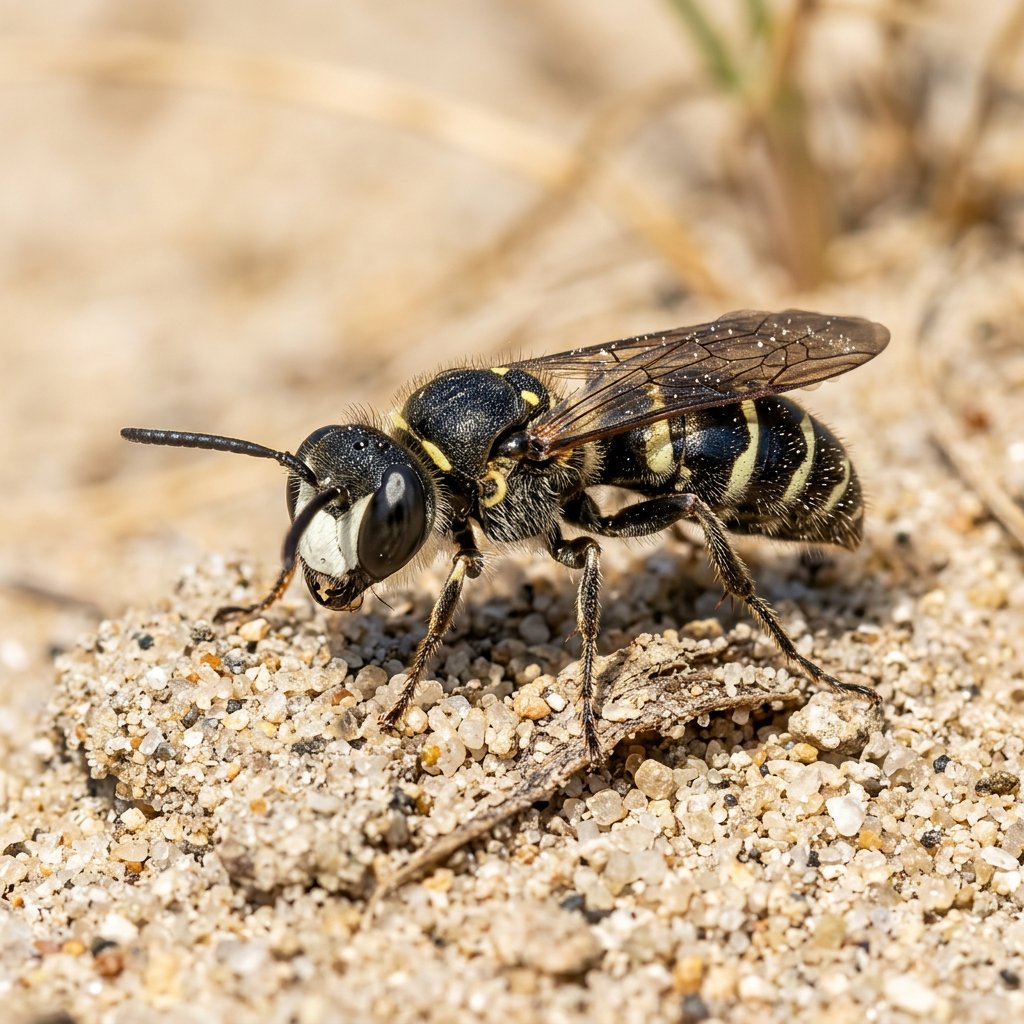
Often called the White-lipped Digger Wasp, this tiny architect is one of the garden's most industrious unsung heroes. Despite being a member of the wasp family, it is a solitary, peaceful neighbor that spends its days excavating miniature tunnels in the soil. It is a master of "pest control," making it a welcome guest for any gardener tired of sap-sucking insects.
🔍 How to Identify
- ⬜ The "White Lip": Its most defining feature is the silvery-white patch on its lower face (the clypeus), which looks like it has been dipped in powdered sugar.
- ⬛ Compact Build: It has a very small, matte-black body, usually measuring only 4 to 6 millimeters—roughly the size of a grain of rice.
- ⏹️ Square Head: Like many of its cousins in the Crabronidae family, it has a disproportionately large, blocky head that gives it a rugged, "tough" appearance under a magnifying glass.
🌲 Habitat & Ecology
- ⏳ Subterranean Architect: You will most likely find them in sunny, open spots with sandy or loose soil. They love the gaps between garden paving stones or the edges of dirt paths where they can dig their nesting burrows.
- 🎯 The Specialized Hunter: Unlike social wasps that scavenge for sugar, this wasp is a specialized predator. Females hunt small "True Bugs" (Miridae) and flies, paralyzing them with a sting and dragging them underground to feed their developing larvae.
⚠️ Safety & Toxicity
- 🐝 Status: Low-risk / Non-aggressive.
- 🛡️ Details: Because these are solitary wasps, they do not have a hive to defend. They have no interest in humans and will only sting if they are physically squeezed or stepped on with bare feet. The sting is very mild compared to a hornet or a yellowjacket.
✨ Fun Fact
Despite their tiny size, Lindenius albilabris are incredibly precise navigators. After flying far from their burrow to hunt, they use visual "landmarks"—like a specific pebble or a twig—to find the entrance to their home, which is often no wider than a pencil lead!
More Details








