Info
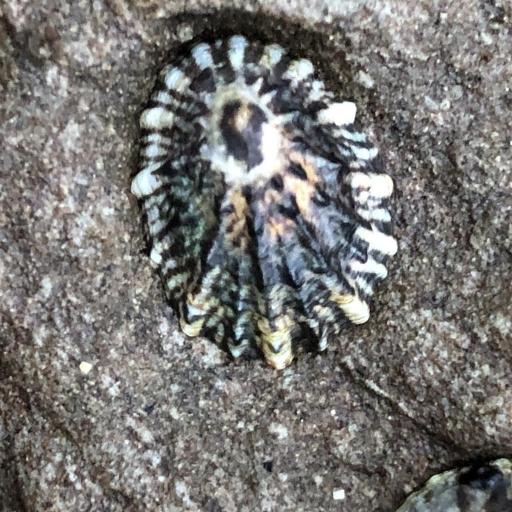
While it may look like a strange, armored bug clinging to the rocks, Lottia scabra—better known as the Rough Limpet—is actually a hardy marine mollusk. Often found in the "splash zone" of the Pacific coast, these resilient creatures are the tiny architects of the shoreline, spending their lives battling crashing waves and the drying heat of the sun.
🔍 How to Identify
- 🐚 The Shell: Look for a low, cone-shaped shell with a very "ribbed" or scalloped texture. The edges are often irregular and "toothed" rather than smooth.
- 🎨 Camouflage: Its coloration is a mottled mix of dull grey, white, and tan, designed to mimic the appearance of salt-crusted rocks and barnacles.
- 👟 The Foot: Beneath the shell lies a singular, powerful muscular "foot" that acts as both a motor for crawling and a high-pressure suction cup.
🌊 Habitat & Ecology
- 🏠 The Home Scar: These limpets are famous for "homing." They grind their shell into the rock to create a perfect, airtight fit called a "home scar." They leave to feed but always return to this exact spot to prevent drying out during low tide.
- 🍽️ Algae Grazer: Acting like a miniature lawnmower, the Rough Limpet uses a sandpaper-like tongue (radula) to scrape microscopic algae off the rocks under the cover of night or high tide.
- 🛡️ Wave Warrior: Their low-profile shape is aerodynamically designed to let heavy surf flow right over them without knocking them loose.
⚠️ Safety & Toxicity
- ✅ Harmless: The Rough Limpet is non-toxic and possesses no stinger, venom, or bite. They are completely safe for humans to observe.
- 🚫 Hands Off: Please do not attempt to pry them off the rocks. Their suction is so strong that pulling them can tear their internal muscles or damage the "home scar," which often leads to the animal’s death from dehydration.
- 🐾 Beach Paws: While non-toxic, the ridges on their shells can be quite sharp; keep an eye on curious dogs exploring tide pools to avoid minor paw scrapes.
✨ Fun Fact
The Rough Limpet is a creature of habit! Scientists have tracked individuals and found that they can navigate back to their specific "home scar" from several feet away, using chemical trails and "memory" of the rock’s texture to find their way back in the dark.
More Details








