Info
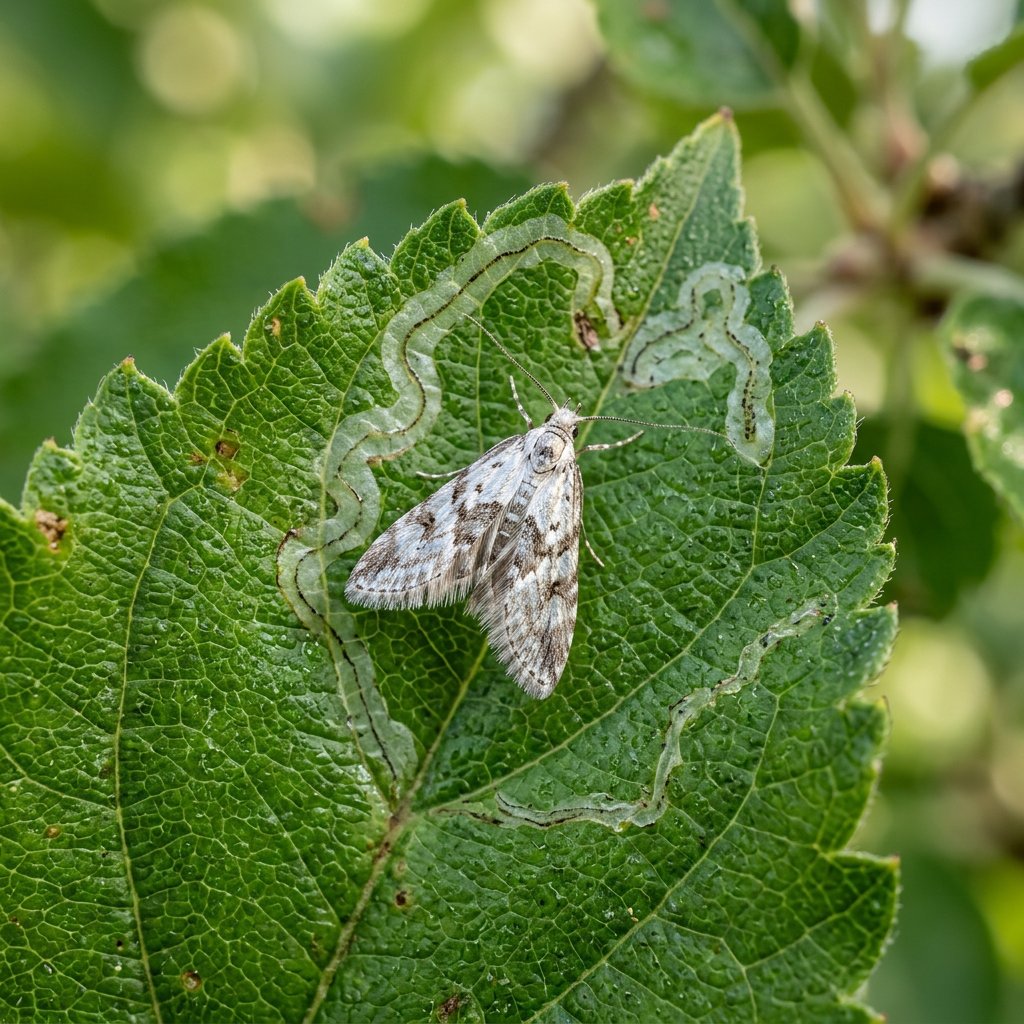
Commonly called the Apple Leaf Miner, this tiny moth is a master of "secret" gardening. While you might never spot the adult moth fluttering about, you’ve likely seen its artistic—and sometimes frustrating—handiwork etched into the leaves of your fruit trees or birch. It is a miniature architect that turns a single leaf into a private, winding highway.
🔍 How to Identify
- 🦋 The Adult Moth: A delicate, silvery-white moth with a tiny wingspan of only 7–9mm. The wing tips have a distinct black spot surrounded by orange or brown markings, giving it a "jeweled" look under a magnifying lens.
- 🐛 The Larva: A pale, translucent green caterpillar, so small and flat it fits perfectly between the upper and lower layers of a leaf.
- 🎨 The "Mine": The most recognizable feature isn't the insect itself, but the long, narrow, serpentine trail it leaves. This trail starts as a thin line and widens as the larva grows, often featuring a dark line of "frass" (waste) down the center.
🌲 Habitat & Ecology
- 🍎 A Selective Diner: These insects are generally considered "foes" to orchard owners. They specifically target the Rosaceae family—think apples, cherries, plums, and hawthorn—but they are also very fond of Birch trees.
- 🏠 The Inner Sanctum: Unlike many caterpillars that eat the whole leaf, these larvae are "leaf miners." They live entirely inside the leaf tissue, protected from many predators and the weather while eating the nutritious middle layer.
- 🕸️ The Silken Hammock: When it is time to transform into an adult, the larva exits the leaf and spins a unique, ribbed silken cocoon. It looks like a tiny white hammock suspended on the underside of a leaf or on the bark.
⚠️ Safety & Toxicity
- ✅ Status: Completely harmless to humans and pets.
- 🌿 Plant Impact: While the "scribbles" on your leaves can look alarming, a few mines won't kill a healthy tree. However, a heavy infestation can cause premature leaf drop, which might weaken a young or stressed tree over time.
✨ Fun Fact
The winding trails of the Lyonetia clerkella were historically compared to handwriting or maps. In some European folklore, these mysterious patterns were thought to be secret messages or "signatures" left behind by woodland spirits.
More Details








