Info
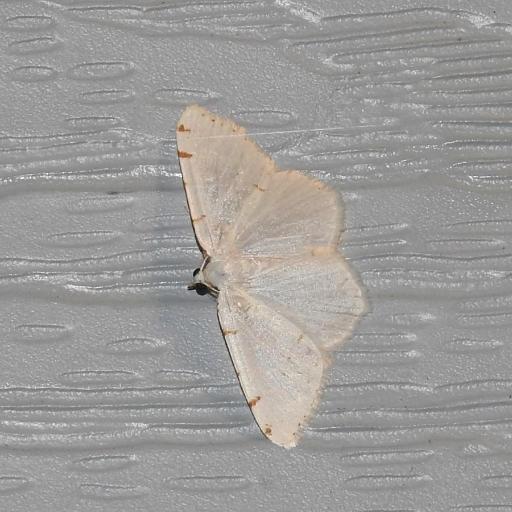
Known as the Lesser Maple Spanworm Moth, this delicate creature is a master of subtlety. Often mistaken for a stray scrap of paper or a fallen petal, it flits through North American deciduous forests and suburban backyards with a ghostly grace. While its scientific name, pustularia, might sound a bit intimidating, it simply refers to the tiny, "pustule-like" spots that dot its wings.
🔍 How to Identify
- ☁️ Wing Color: The wings are a pristine, ghostly white or pale cream, looking almost translucent under moonlight.
- 〰️ Distinctive Lines: Look for three faint, yellowish-orange or light brown wavy lines that stretch horizontally across the forewings.
- 📍 The "Pustules": The most reliable ID feature is a series of tiny, dark reddish-brown dots located right on the leading edge (costa) of the front wings.
🌲 Habitat & Ecology
- 🍁 The Maple Connection: As the name suggests, these moths are inextricably linked to Maple trees. The larvae (caterpillars) feed almost exclusively on the leaves of Red Maple, Sugar Maple, and Silver Maple.
- 🦎 The "Inchworm" Walk: Before they become moths, the larvae are classic "inchworms." Because they lack middle legs, they must arch their bodies into a loop to move forward, appearing as if they are "spanning" or measuring the branch they are on.
- 🌙 Night Owl: You are most likely to spot the adult moth resting near porch lights or on the undersides of leaves during the day, where their pale color helps them blend into bright, sun-dappled environments.
⚠️ Safety & Toxicity
- ✅ Harmless: The Lesser Maple Spanworm is a complete "friend" to humans. It does not bite, sting, or carry any known diseases.
- 🍃 Garden Impact: While the caterpillars eat maple leaves, they rarely appear in high enough numbers to cause serious damage to healthy trees. They are a vital food source for local birds and predatory insects, making them a healthy part of a garden's ecosystem.
✨ Fun Fact
The "Spanworm" family name, Geometridae, literally translates from Greek to "Earth-measurer." This is a nod to the way the caterpillars move—it looks exactly like they are using their bodies as a tiny measuring tape to calculate the length of every twig they climb!
More Details








