Info
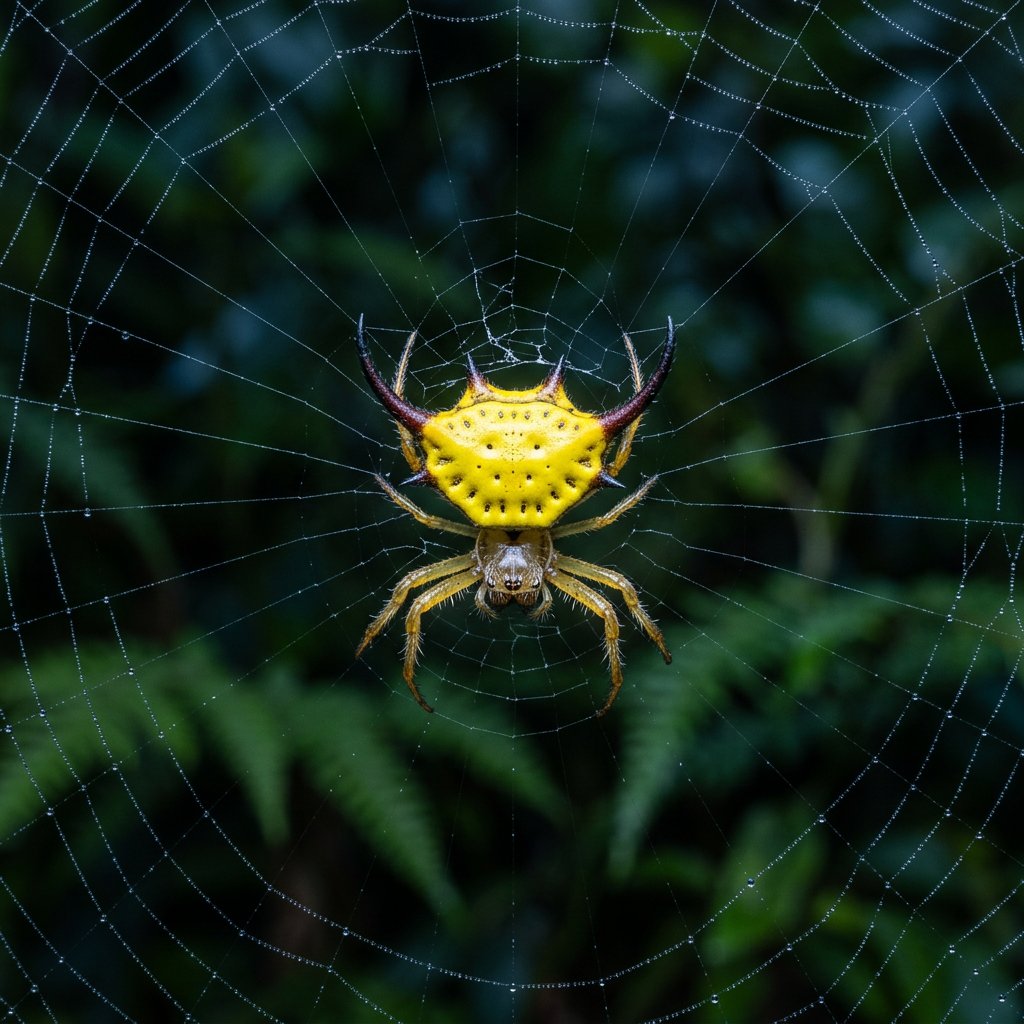
Often called the Long-horned Orb Weaver, this spider looks more like a piece of ornate, gothic jewelry or a miniature forest dragon than a common garden inhabitant. Found primarily in the tropical forests of Southeast Asia, its silhouette is one of the most unmistakable and dramatic in the entire arachnid world.
🔍 How to Identify
- 📯 Extravagant Spines: The most striking feature is a pair of incredibly long, dark, and slender spines that curve upward and outward from the sides of the abdomen.
- 🛡️ Hardened Abdomen: Unlike the soft bodies of many spiders, its abdomen is a tough, shell-like "scutum," often brightly colored in shades of yellow, white, or orange with distinct black spots.
- 🕸️ Vertical Architect: It spins a classic, circular "orb" web, usually positioned high between trees or shrubs to catch flying insects.
🌲 Habitat & Ecology
- 🏹 The Survival Horns: Those dramatic spines aren't for attacking prey; they are a brilliant defensive tool. Their length and hardness make the spider nearly impossible for small birds or lizards to swallow, acting like a built-in suit of armor.
- 🍃 Forest Floor to Canopy: You will typically find them in secondary forests or overgrown gardens. They prefer areas with high humidity where they can stretch their webs across wide gaps between foliage.
- 🦟 Pest Controller: As a passive hunter, it stays in the center of its web, vibrating the silk to confuse predators while waiting for flies, moths, and mosquitoes to stumble into the trap.
⚠️ Safety & Toxicity
- 🛡️ Harmless Friend: Despite its "scary" or "alien" appearance, the Long-horned Orb Weaver is not aggressive toward humans and is considered a "friend" to gardeners.
- 🩹 Minor Bite: They rarely bite unless physically squeezed. If a bite does occur, the venom is very weak—medically insignificant—and usually results in nothing more than minor, temporary redness or itching.
✨ Fun Fact
✨ In some regions, the female's spines can be up to three times the length of her actual body! While she looks like a formidable warrior, the male of the species is tiny, plain, and lacks the dramatic horns entirely.
More Details








