Info
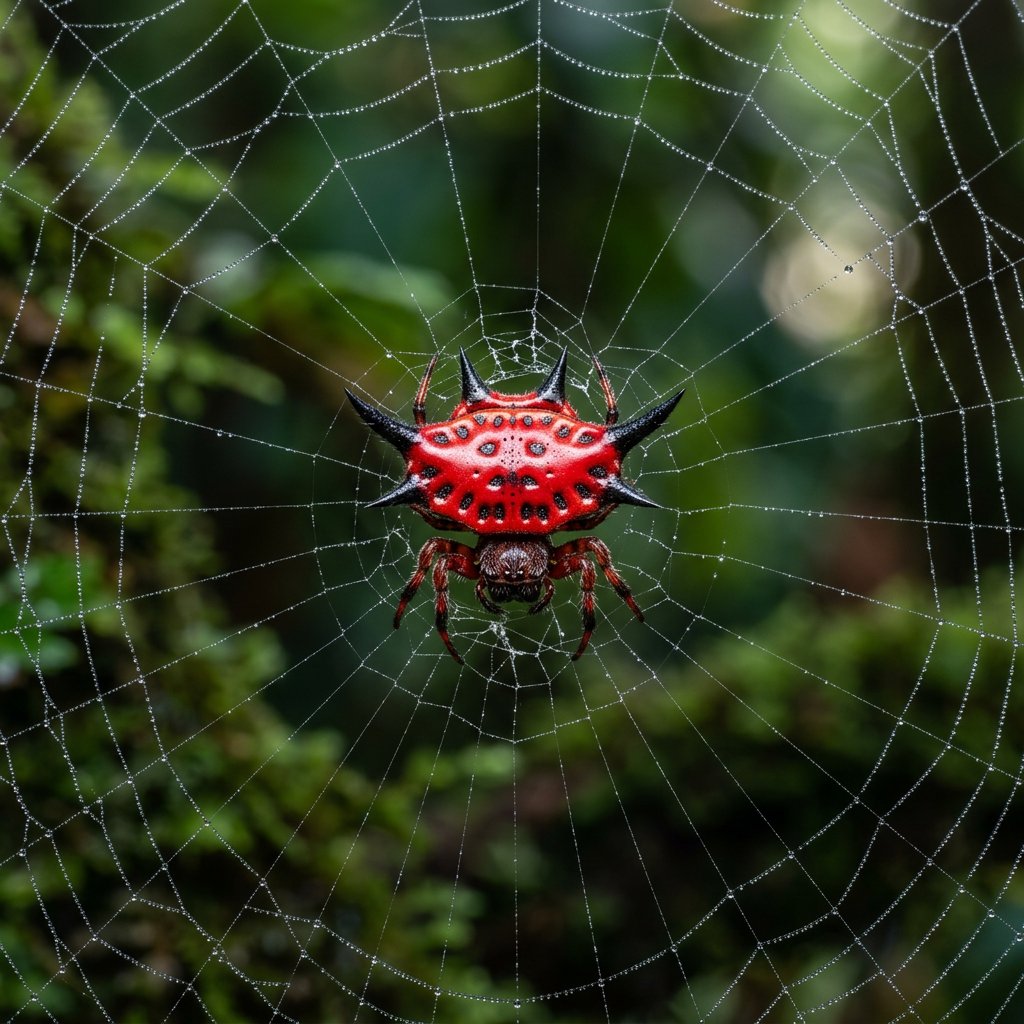
Meet the "Devil's Horns" of the arachnid world. Often called Hasselt’s Spiny Spider, this Southeast Asian native looks like a tiny, porcelain jewel that has sprouted a pair of intimidating, curved obsidian swords. Despite its extraterrestrial appearance, it is a shy architect that plays a vital role in keeping forest insect populations in check.
🔍 How to Identify
- 🪝 The Spines: The most striking feature is a pair of incredibly long, black, curved spines that grow from the sides of the abdomen. These "horns" can be several times longer than the spider’s actual body.
- 🎨 The Abdomen: The central body is usually a brilliant creamy white or vibrant yellow. It is dotted with small, dark circular indentations called "sigilla," which look like tiny eyes or rivets on a piece of armor.
- 🕸️ The Web: They spin classic, circular orb-webs. If you look closely at the silk, you might see small tufts of debris or "decorations" that the spider uses to make the web visible to birds so they don't fly through its hard work.
🌲 Habitat & Ecology
- 🦟 Aerial Predator: As a master orb-weaver, this spider is a classic "friend" to humans. It sits silently in the center of its web, waiting to snag mosquitoes, flies, and small beetles that wander into its trap.
- 🍃 Forest Dweller: You are most likely to spot them in the humid secondary forests of Southeast Asia. They prefer to hang their webs at head-height between shrubs or trees where the sunlight hits the clearing, attracting flying prey.
⚠️ Safety & Toxicity
- 🟢 Status: Harmless and non-aggressive.
- 🛡️ Defensive Only: The intimidating spines are not used for hunting or stinging. Instead, they are a clever "anti-swallow" mechanism. If a bird tries to eat the spider, the long, rigid spines make it nearly impossible to gulp down.
- 🧤 Bite Risk: While they do possess venom (like almost all spiders) to subdue flies, it is not medically significant to humans. They are very reluctant to bite and would much rather drop to the ground and hide if disturbed.
✨ Fun Fact
The Macracantha hasselti is the only species in its genus, making it a unique evolutionary "one-off." Scientists believe its elaborate spines also act as a balancing pole, helping the spider maintain its position in the center of its web during heavy tropical rainstorms and high winds.
More Details








