Info
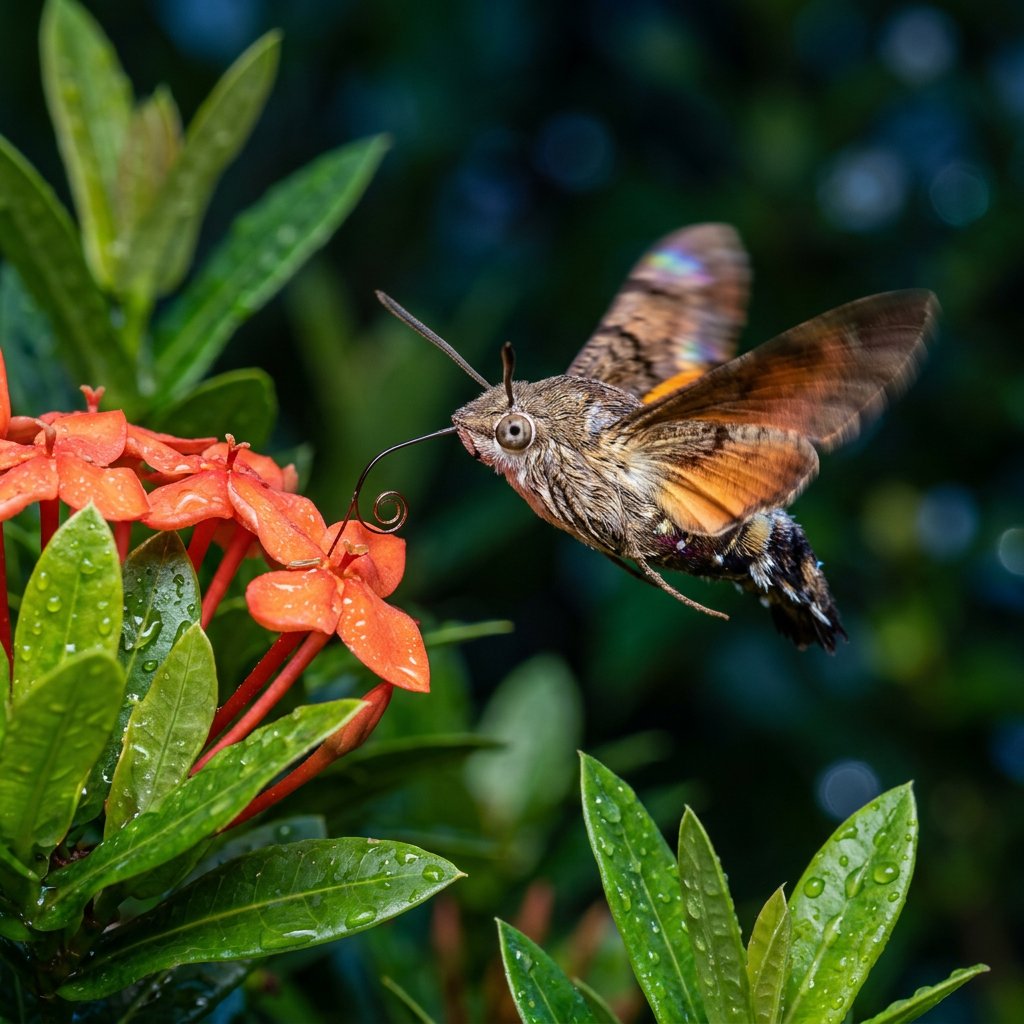
Often called the "Miniature Hummingbird" of the insect world, the African Hummingbird Hawkmoth (Macroglossum trochilus) is a master of disguise and a marvel of convergent evolution. While it looks and acts remarkably like a tiny bird, it is actually a highly specialized, day-flying moth. Its rapid-fire wingbeats and darting movements often confuse observers, making it one of the most delightful surprises to find in a sunny garden.
🔍 How to Identify
- 🦋 The Wings: The forewings are generally a rich, earthy brown, while the hindwings flash a bright orange or copper color in flight. Some individuals show subtle translucent "windows" near the wing tips.
- 🖌️ The Tail Brush: The abdomen ends in a distinct, fan-like tuft of dark scales. This "tail" mimics bird feathers and acts as a rudder, allowing the moth to steer with incredible precision.
- 🍭 The Proboscis: It possesses an exceptionally long, straw-like feeding tube that stays coiled against its head until it hovers over a flower to drink nectar.
🌲 Habitat & Behavior
- 🌸 Sun-Loving Pollinator: Unlike most moths that prefer the cover of night, this species is diurnal. It is most active during the brightest parts of the day, darting between nectar-rich flowers like Buddleja or Lantana.
- 🚀 Aerial Acrobatics: These moths are high-energy flyers. They do not land on flowers to feed; instead, they use a "hover-and-sip" technique, maintaining a perfectly still position in mid-air despite their wings beating dozens of times per second.
⚠️ Safety & Toxicity
- 🛡️ Status: Completely harmless and non-aggressive.
- 🌿 Details: The African Hummingbird Hawkmoth has no stinger, cannot bite, and is not toxic to touch. It is safe around children and pets, and its presence is a sign of a healthy, nectar-rich ecosystem.
✨ Fun Fact
The African Hummingbird Hawkmoth is a "smart" flyer! Research suggests they have an excellent spatial memory, allowing them to remember specific patches of flowers and return to the most productive nectar sources at the same time every day.
More Details








