Info
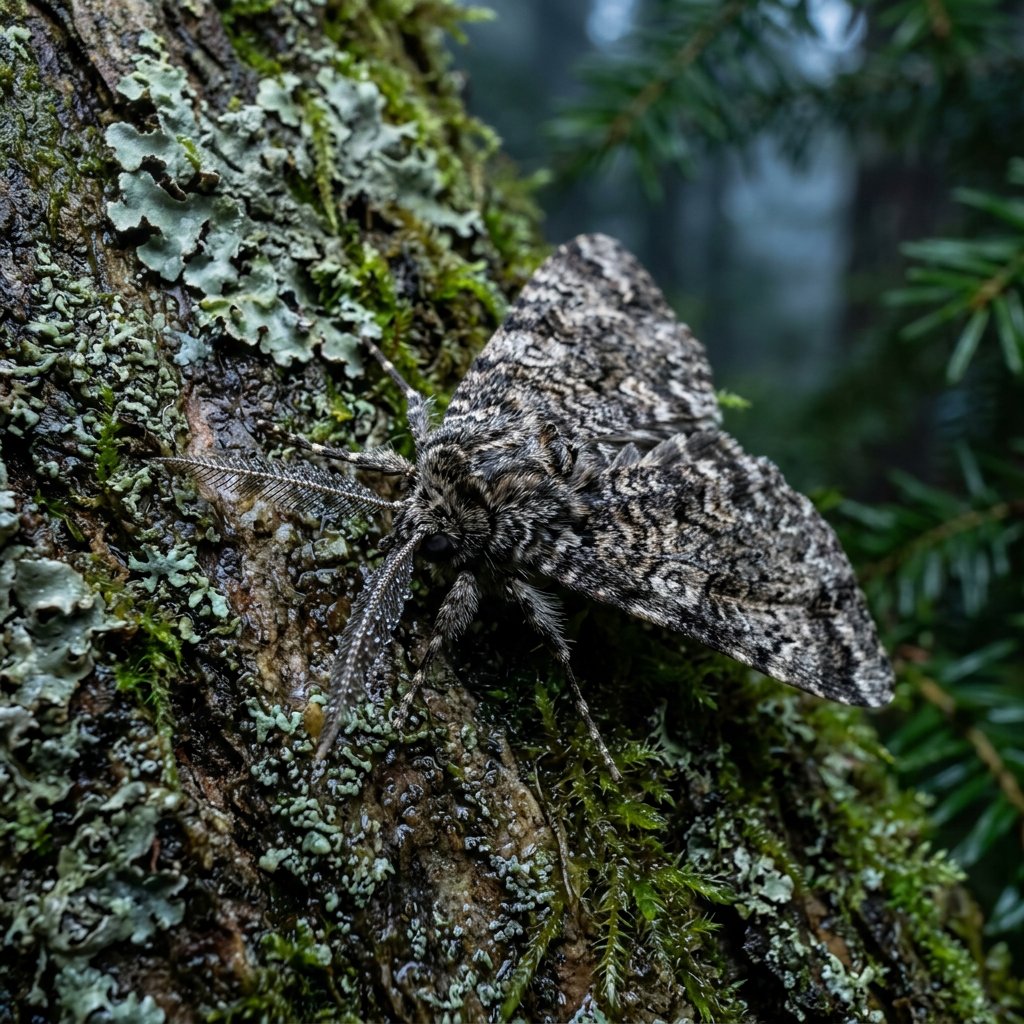
Often referred to as the Signate Melanolophia, this moth is a master of the "hidden in plain sight" technique. If you’ve ever looked at a patch of lichen on a tree trunk and seen it suddenly flutter away, you’ve likely met this camouflage expert. These moths are common forest residents that spend their days pretending to be part of the landscape to avoid hungry birds.
🔍 How to Identify
- 🦋 The Camouflage Pattern: Their wings are a complex mosaic of pale grey, tan, and charcoal-colored wavy lines that perfectly mimic the texture of tree bark or crustose lichen.
- 📐 Resting Posture: Unlike butterflies that hold their wings up, this moth rests with its wings spread completely flat against a surface, minimizing any shadow that might give its position away to predators.
- 📏 Size & Shape: They are medium-sized moths with broad, somewhat triangular wings. When at rest, they form a neat, flat triangle shape that blends seamlessly into the grooves of a tree.
🌲 Habitat & Ecology
- 🌳 Forest Dwellers: You will typically find them in deciduous or coniferous forests. During the day, they cling to the trunks of trees like Birch, Fir, or Maple, which also serve as the primary "nurseries" where they lay their eggs.
- 🌙 Nocturnal Navigators: Like most moths, they are active at night and are frequently drawn to porch lights. In the natural ecosystem, they serve as a vital food source for bats and nocturnal birds.
- 🍃 The Larval Diet: As caterpillars, they are generalist feeders, munching on the leaves of various trees and shrubs, though they rarely occur in high enough numbers to cause significant garden damage.
⚠️ Safety & Toxicity
- 🛡️ Completely Harmless: The Melanolophia is a "friend" to the gardener. They do not bite, sting, or possess any chemical defenses that are harmful to humans.
- 🐾 Pet Safety: These moths are non-toxic. If a curious cat or dog happens to catch one, it poses no health risk, though the "dusty" scales on the wings might cause a sneeze or two.
✨ Fun Fact
The caterpillars of the Melanolophia genus are "inchworms." Because they lack legs in the middle of their bodies, they must draw their hind end up to their front legs, forming a high loop before stretching forward—a movement that makes it look like they are carefully "measuring" the branch they are walking on.
More Details








