Info
Often referred to as the Forest Cockchafer or simply the "May Bug," this chunky beetle is a classic herald of late spring. While its loud, clumsy buzzing might startle you on a warm evening, it is a harmless giant of the woodland edge. Historically, these beetles appeared in such massive numbers that they were even "put on trial" in medieval Europe for their role in crop destruction!
🔍 How to Identify
- 🪶 Fan-Like Antennae: They possess distinctive "clubs" at the end of their antennae; males have seven large "leaves" that they use to sniff out mates, while females have six smaller ones.
- 🟤 Chestnut Wing Covers: Their hard wing cases (elytra) are a warm, reddish-brown color, often dusted with a fine, powdery white hair that gives them a velvety appearance.
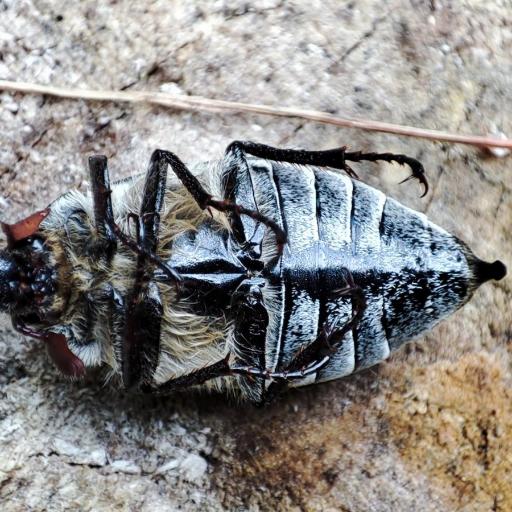
- 🗡️ Short Pointed Tail: The abdomen ends in a narrow, downward-pointing tip called a pygidium. In this specific forest species, the tip is shorter and more blunt than its cousin, the Common Cockchafer.
🌲 Habitat & Ecology
- 🌳 Forest Dwellers: As the name suggests, this beetle prefers the borders of deciduous forests over open farmland. Adults emerge in May to feast on the tender leaves of oak, beech, and maple trees.
- 🌱 Hidden Life Cycle: Most of their life is spent out of sight. They live as large, C-shaped "white grubs" for three to four years underground, slowly growing as they feed on the roots of grasses and young saplings.
⚠️ Safety & Toxicity
- 🛡️ Completely Harmless: The Forest Cockchafer is a "gentle giant." It does not bite, sting, or carry any toxins that are harmful to humans or household pets.
- 💡 Light Seekers: Because they are nocturnal and attracted to artificial light, they may accidentally fly through open windows. Their heavy bodies make a loud "thud" when they hit walls, but they are simply confused and trying to find their way back to the trees.
✨ Fun Fact
In the 14th century, the damage caused by these beetles was so severe that a group of them was "summoned" to a religious court in Lausanne, Switzerland. When the beetles failed to appear in court, they were officially excommunicated by the bishop!
More Details








