Info
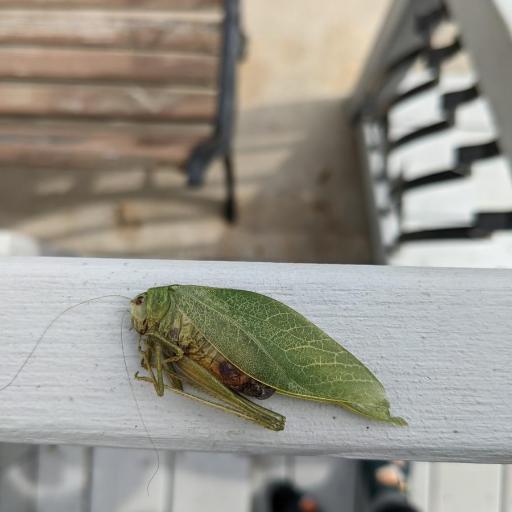
Often mistaken for a stray leaf, Microcentrum—commonly known as the Angle-wing Katydid—is a masterpiece of natural camouflage. These vibrant green insects are the ultimate hide-and-seek champions of the garden, using their bodies to mimic the foliage they live upon. While you might have typed "plant," this insect spends its entire life pretending to be one to avoid predators!
🔍 How to Identify
- 🍃 Wing Venation: Their forewings are broad and leaf-shaped, featuring a delicate network of "veins" that perfectly mimic the midrib and lateral veins of a real leaf.
- 📏 Body Profile: They have a distinctively "humped" or arched back and a laterally flattened body, making them nearly invisible when viewed from the side against a twig.
- 📡 Long Antennae: Unlike grasshoppers, katydids have extremely long, thread-like antennae that often extend well past the end of their bodies.
🌲 Habitat & Ecology
- 🌳 Canopy Dwellers: These insects are rarely found on the ground; they prefer the safety of high tree crowns, ornamental shrubs, and thick garden hedges where they can blend in.
- 🎵 Nocturnal Musicians: They are most active at night. Males produce a rhythmic "clicking" or "thumping" sound by rubbing their wings together (stridulation) to attract females during the late summer months.
- 🍽️ Gentle Herbivores: They feed primarily on the leaves of deciduous trees and shrubs. While they do nibble on your plants, they are solitary and rarely appear in large enough numbers to cause significant garden damage.
⚠️ Safety & Toxicity
- 🛡️ Status: Completely harmless and non-aggressive.
- 🤏 Details: They do not sting and are not toxic to humans or pets. If handled very roughly, a large adult might give a tiny, harmless "nip" with its mandibles, but they generally prefer to remain still or jump away when threatened.
✨ Fun Fact
Katydids don't hear with their heads! Their "ears" (called tympana) are actually located on their front legs, just below the knee joint, allowing them to pick up the vibrations of mating calls or approaching predators.
More Details








