Info
Often called the "Jewel of the Amazon," the Morpho Helenor is one of the most iconic butterflies in the world. Famous for its dazzling, metallic blue wings that seem to glow in the tropical sun, it is a staple of Central and South American rainforest folklore. In many cultures, seeing a Blue Morpho is considered a sign of good luck or a "wish-bringer" dancing through the forest canopy.
🔍 How to Identify
- 🦋 Iridescent Upper Wings: The most striking feature is the brilliant, metallic blue on the topside of the wings. This color isn't caused by pigment, but by microscopic scales that reflect light like a prism.
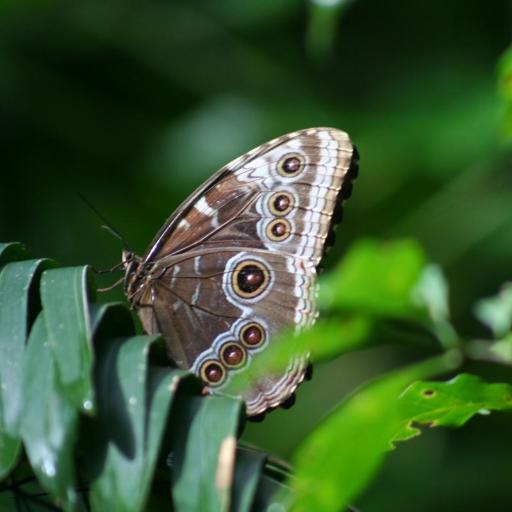
- 👁️ The "Owl" Underside: When at rest, the wings are closed to reveal a dull, chocolate-brown underside decorated with large "eyespots" (ocelli). This mimics the eyes of a larger predator to scare off birds.
- 📏 Impressive Span: This is a large butterfly, often reaching a wingspan of 5 to 6 inches, making its erratic, "flashing" flight pattern easy to spot from a distance.
🌲 Habitat & Ecology
- 🍍 A Unique Diet: Surprisingly, the Morpho Helenor rarely visits flowers for nectar. Instead, it uses its long proboscis to sip juices from fermenting fruit, tree sap, and even nutrient-rich mud or decomposing organic matter.
- 🍃 Rainforest Patrol: They are typically found in the humid forests of Central and South America. They love "light gaps"—sunlit openings in the forest created by fallen trees—where they can bask and display their vibrant colors.
⚠️ Safety & Toxicity
- ✅ Perfectly Harmless: The Morpho Helenor is a gentle giant. It possesses no sting, no bite, and is not known to be toxic to humans or pets.
- 🚫 Fragile Beauty: The "blue" on their wings is extremely delicate. Touching the wings can rub off the microscopic scales, which doesn't just ruin the color—it can make it difficult for the butterfly to fly or stay warm.
✨ Fun Fact
The brilliant blue of the Morpho is an optical illusion! If you were to look at a wing scale under a microscope without any light, it would actually appear brown. The "blue" is created by the way the physical structure of the wing scales scatters light, a phenomenon scientists call "structural coloration."
More Details








