Info
Often found wandering around willow trees or rose bushes, members of the Nematus genus are the ultimate garden mimics. Though they look remarkably like wasps, they are actually "sawflies"—primitive relatives of bees and ants that completely lack a stinger. They get their name from the female's specialized egg-laying tool, which she uses to move through plant tissue with the precision of a microscopic carpenter.
🔍 How to Identify
- 🐝 The "Waistless" Body: Unlike true wasps, which have a thin "wasp waist," Nematus sawflies have a thick, cylindrical connection between their thorax and abdomen.
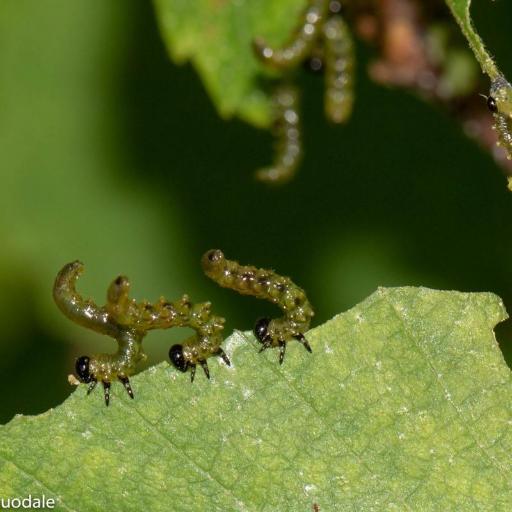
- 🐛 Larval Leg Count: Their larvae look almost identical to moth caterpillars, but you can spot the difference by counting the "prolegs" (fleshy stumpy legs); sawflies have six or more pairs, while caterpillars have five or fewer.
- 🛡️ The "S" Pose: When a colony of larvae feels threatened, they will simultaneously arch their bodies into a synchronized "S" or "U" shape to startle potential predators.
🌲 Habitat & Ecology
- 🍃 Leaf Specialists: These insects are most at home in temperate gardens and woodlands, specifically favoring Willow, Poplar, and Birch trees where the larvae can feed in large, gregarious groups.
- 🪚 Hidden Nurseries: The female uses her serrated, saw-like ovipositor to cut neat slits into leaf veins or stems. She then tucks her eggs inside the plant’s own skin to keep them hydrated and safe from predators.
- 🍂 Garden Role: While they are important food sources for birds and predatory wasps, a large population can quickly defoliate a host plant, making them a bit of a nuisance for ornamental gardeners.
⚠️ Safety & Toxicity
- 🛡️ Harmess to Humans: Despite their intimidating "wasp-like" colors (often yellow and black), Nematus insects cannot sting or bite humans. They are entirely safe to observe up close.
- 🐾 Pet Safety: They are not toxic to pets. If a curious dog or cat eats a larva, the worst result is usually just a bit of a localized "icky" taste from the larva's defensive secretions.
✨ Fun Fact
The "saw" of the female Nematus is so sharp and efficient that it can cut through tough plant fibers that would blunt a tiny steel needle. Some species even inject a chemical that forces the plant to grow a "gall"—a weird, berry-like swelling—to provide the baby larvae with a custom-built home!
More Details








