Info
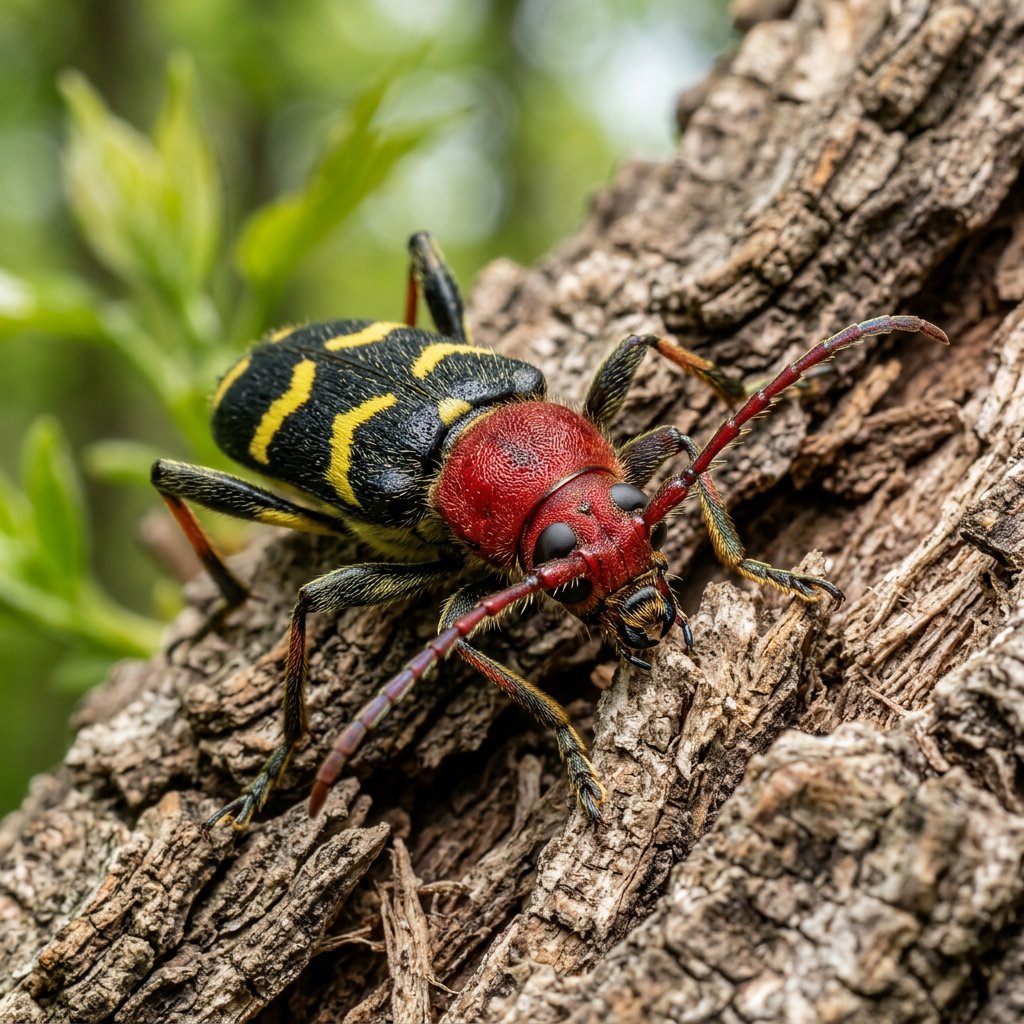
Commonly known as "Wasp-mimic Longhorn Beetles," these clever insects are masters of evolutionary disguise. While they look like they could deliver a painful sting, it is all an elaborate act designed to keep birds and predators at bay. You’ll often spot them scurrying across fallen logs or sun-drenched fences, moving with a jerky, nervous energy that mimics the behavior of a yellowjacket.
🔍 How to Identify
- 🐝 The Great Disguise: They feature striking yellow or white transverse bands across a dark brown or reddish-brown body, mimicking the warning colors of a wasp.
- 📏 Body Shape: Unlike the "armored" look of many beetles, Neoclytus has a very slender, cylindrical body and a rounded thorax (the middle section).
- 🦵 Spindly Legs: Their legs are notably long and thin, which allows them to run with surprising speed rather than relying solely on flight.
🌲 Habitat & Ecology
- 🪵 Woodland Cleaners: These beetles are primary decomposers. The larvae (roundheaded borers) tunnel into the sapwood of dying or recently fallen hardwoods like Ash, Oak, and Hickory, helping to break down the wood and return nutrients to the soil.
- 🏃 Wasp-like Movement: Their behavior is just as important as their looks. When disturbed, they don't just fly away; they run in zig-zag patterns and flick their antennae exactly like a foraging wasp would.
- ☀️ Sun Lovers: Unlike many beetles that are nocturnal, Neoclytus species are diurnal. They are most active during the brightest, hottest parts of the day, often found on freshly cut firewood or clearing edges.
⚠️ Safety & Toxicity
- 🛡️ Harmless Mimic: Despite their scary appearance, they have no stinger and are not venomous. They are completely harmless to humans and pets.
- 🪵 Household Note: If you bring firewood into your home during the winter, you might find these "wasps" emerging in your living room as the wood warms up. Don't panic—they cannot "infest" your furniture or structural wood, as they only lay eggs in fresh or unseasoned bark.
✨ Fun Fact
The Red-headed Ash Borer (Neoclytus acuminatus) is such a dedicated actor that it even produces a faint buzzing sound by vibrating its wings when it feels threatened, completing the "I'm a dangerous wasp" performance!
More Details








