Info
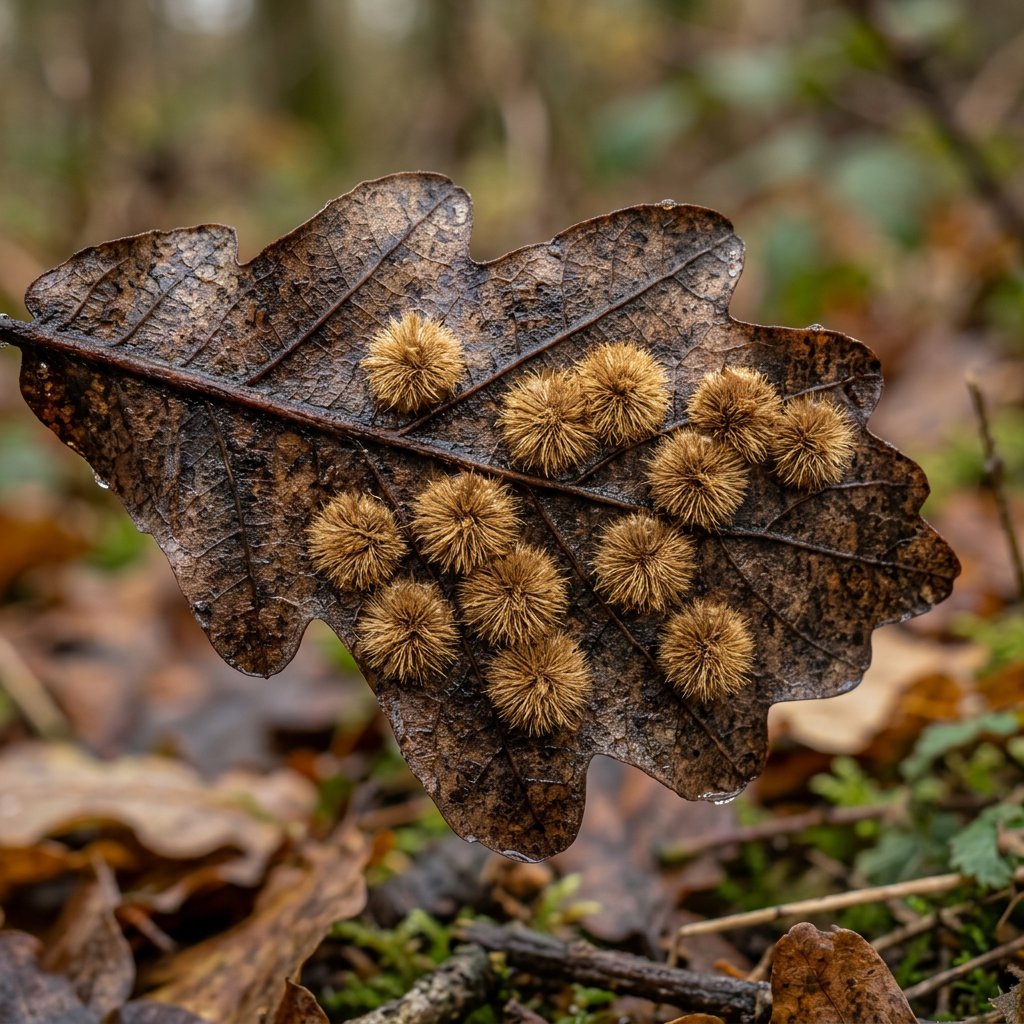
Known as the Silk Button Gall Wasp, this tiny architect is responsible for one of the most mesmerizing patterns found in the forest. While the wasp itself is nearly invisible to the naked eye, it leaves behind thousands of golden, donut-shaped "buttons" on the underside of oak leaves. In folklore, these intricate structures were sometimes thought to be fairy coins scattered across the woods.
🔍 How to Identify
- 🪡 The Gall: Small, circular discs (2–3mm) with a distinct depression in the center, resembling a tiny silk-covered button or a golden donut.
- ✨ The Texture: They are covered in fine, radiating golden or light-brown hairs that give them a shimmering, "silky" appearance.
- 🦟 The Wasp: The actual insect is a microscopic, dark, shiny wasp. You are much more likely to see their "nursery" (the gall) than the wasp itself.
- 🍃 Placement: They are almost always found in large clusters on the underside of Oak leaves (Quercus species), often numbering in the hundreds on a single leaf.
🌲 Habitat & Ecology
- 🌳 The Oak Connection: These wasps are host-specific, meaning they rely entirely on Oak trees. They manipulate the tree's own hormones to force it to grow these protective "buttons" to house their larvae.
- 🔄 Two-Stage Life: They have a complex life cycle involving a "sexual" generation in the spring (which creates inconspicuous blister galls) and an "asexual" generation in the summer that creates the famous silk buttons.
- 🍂 Winter Survival: In autumn, the silk buttons detach from the leaves and fall to the ground. The larvae overwinters inside the button on the forest floor, protected from the frost by the leaf litter.
⚠️ Safety & Toxicity
- ✅ Status: Completely harmless to humans and pets. These wasps do not have a functional stinger for defense and cannot bite.
- 🌳 Tree Health: While a heavy infestation can look dramatic and may cause leaves to drop slightly early, they generally do not cause long-term harm to a healthy, mature Oak tree. No chemical treatment is usually necessary.
✨ Fun Fact
The Silk Button Gall Wasp is a master of "Parthenogenesis." The generation that emerges from the silk buttons in the spring consists entirely of females, who can lay fertile eggs to produce the next generation without ever needing a male partner!
More Details








