Info
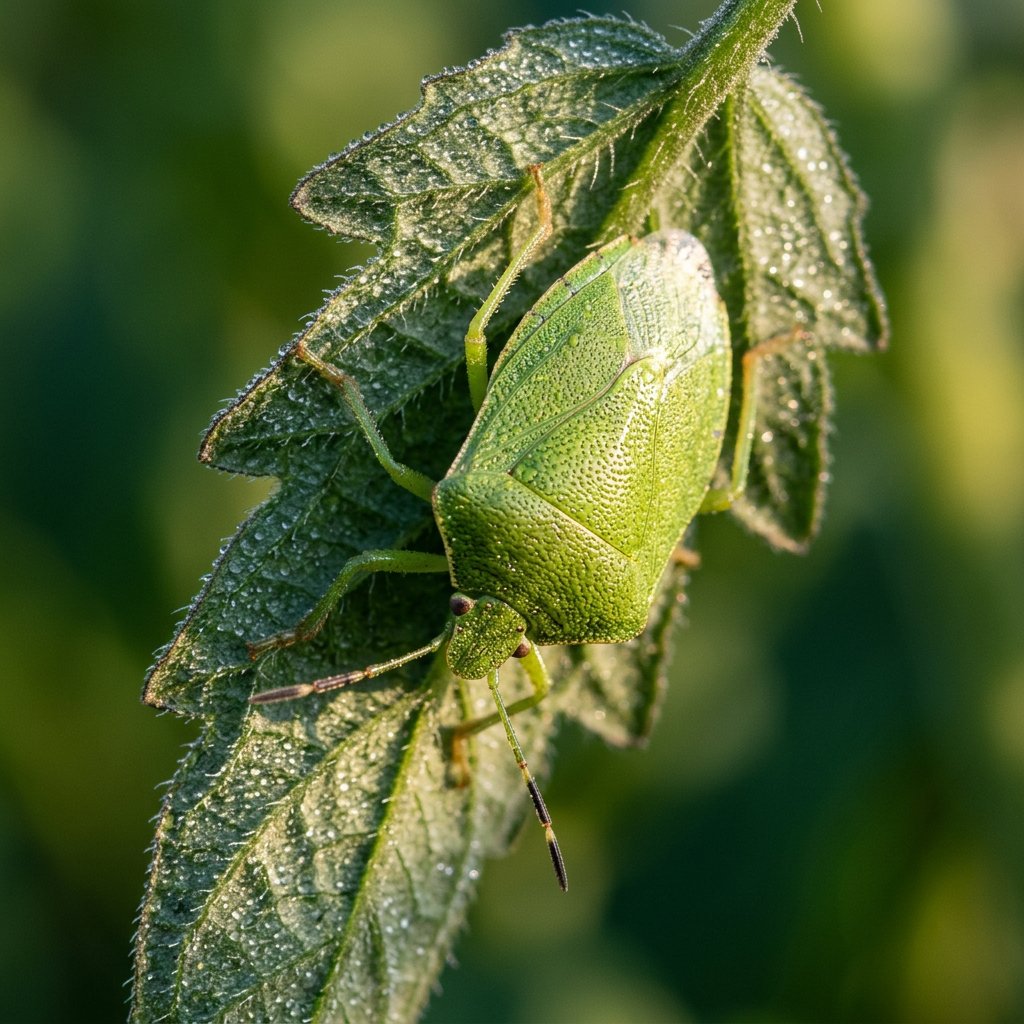
Known globally as a persistent garden "guest," the Southern Green Stink Bug is a master of the "chemical defense." Often called the "Shield Bearer," this insect is easily recognized by its vibrant, leaf-green color and its tendency to turn up exactly where your prize tomatoes are ripening. While it may look harmless, its presence is a signal for gardeners to stay alert.
🔍 How to Identify
- 🛡️ Shield Shape: The body is broad and flat, forming a classic "pentatomid" or shield shape that is wider at the shoulders than at the tail.
- 🟢 Vivid Greenery: Adults are a solid, bright lime-green. Unlike some cousins, they lack bold patterns, though they may turn a dull brownish-bronze during the winter months.
- ⚪ The Three Dots: If you look closely at the top of the "shield" on its back, you’ll see a row of three to five tiny, pale-white spots that act like a biological serial number.
🌲 Habitat & Ecology
- 🍴 Sap Suckers: These insects are equipped with a needle-like proboscis. Instead of chewing, they pierce the skin of fruits and vegetables—especially tomatoes, beans, and peaches—to suck out the sugary juices.
- 🍃 Master of Hiding: They prefer the underside of leaves or the dense interior of vegetable patches. Their green color provides nearly perfect camouflage against the foliage of the plants they feed on.
- 🌬️ Seasonal Travelers: They are strong fliers and will move from wild weeds into your garden as soon as the weather warms up and your vegetables begin to fruit.
⚠️ Safety & Toxicity
- 🦨 The Stink Factor: They are completely harmless to humans in terms of biting or stinging. However, if they feel threatened or are crushed, they release a pungent, foul-smelling liquid from glands on their thorax.
- 🍅 Crop Damage: While they won't hurt you, they hurt your harvest. Their feeding causes "cat-facing" (deformities) on fruit and can leave bitter, corky white spots under the skin of tomatoes.
- 🐾 Pet Interaction: If a curious dog or cat tries to eat one, the bitter chemical spray may cause them to drool or paw at their mouth, but it is not considered toxic.
✨ Fun Fact
The "stink" produced by these bugs isn't just a random smell; it’s a complex chemical cocktail. To other stink bugs, different scents act as a language—certain smells are "alarm pheromones" that tell the rest of the colony to hide, while others are "aggregation pheromones" that invite friends to a tasty plant!
More Details








