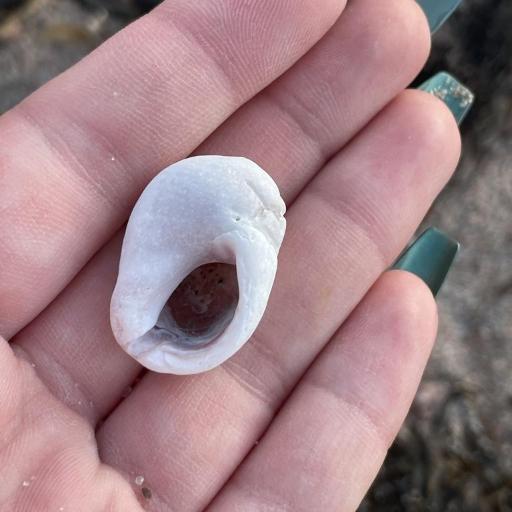
Info
While often mistaken for a land-dweller due to its common name, Nucella lapillus (the Dog Whelk) is actually a predatory sea snail rather than an insect. Known as the "Wolf of the Shore," this small mollusk is a legendary figure in coastal folklore, famous for producing a rare purple dye once reserved for ancient royalty.
🔍 How to Identify
- 🐚 The Shell: A sturdy, pointed spiral shell typically featuring 5 to 6 "whorls." It is much thicker than a common garden snail's shell to withstand crashing waves.
- 🎨 Chameleon Colors: Their color is a reflection of their diet! Snails eating mussels often have dark, banded shells, while those eating barnacles are usually white or pale yellow.
- 👃 Siphonal Notch: At the base of the shell opening, you’ll find a small "spout" or groove which the snail uses to "sniff" the water for its next meal.
🌊 Habitat & Ecology
- 🪨 The Intertidal Zone: You will find them clinging to rocks on the shoreline. They are masters of the "grip," using a muscular foot to stay attached when the tide pulls out.
- ⚔️ The Drill Master: These are fierce predators. They use a sandpaper-like tongue (radula) and a special chemical to drill a perfect, tiny hole through the shells of barnacles and mussels to eat them.
⚠️ Safety & Toxicity
- ✅ Safe to Handle: Dog Whelks are completely harmless to humans. They do not bite, sting, or carry venom that affects us.
- 🐚 Physical Sharpness: While not toxic, their shells can be quite sharp. Use caution when walking barefoot in rocky tide pools to avoid small cuts.
✨ Fun Fact
In ancient times, a relative of this snail was used to create "Tyrian Purple." It took thousands of snails to produce just one gram of dye, making purple clothing so expensive that, for centuries, only emperors and kings were legally allowed to wear it!
More Details








