Info
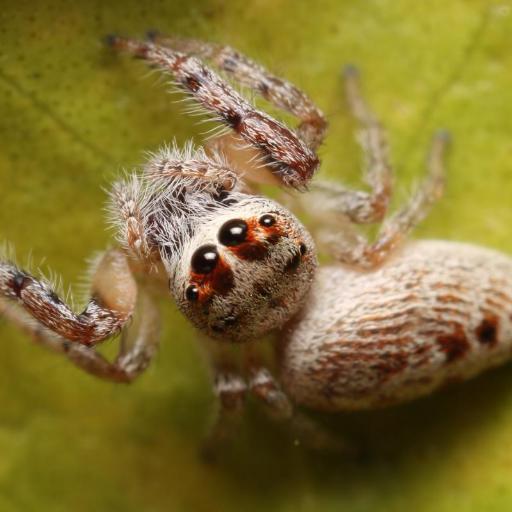
Meet the "Cyclops Jumper," a tiny acrobat named after the one-eyed giant of Greek myth due to its massive, forward-facing primary eyes. While many people are wary of spiders, this species is widely considered a "friend" to gardeners, acting as a highly efficient, mobile pest control unit. With their curious "head tilts" and incredible agility, they behave more like tiny mammalian hunters than typical web-spinning spiders.
🔍 How to Identify
- 👁️ The "Big" Eyes: They possess two enormous, headlight-like eyes in the center of their face which provide high-resolution, 3D vision, flanked by smaller eyes for peripheral movement.
- 🦵 Robust Build: Unlike spindly house spiders, these have a stocky, muscular body and thick front legs designed for pouncing rather than crawling.
- 🎨 Camouflage Patterns: Their bodies are typically a mix of creamy whites, tans, and dark browns, often with a distinct "v" or "u" shaped mark on the thorax that helps them vanish against tree bark.
🌲 Habitat & Ecology
- ☀️ Sun-Loving Hunters: You will rarely find them in dark corners; they prefer sun-drenched garden leaves, fences, and tree trunks where they use the bright light to track prey.
- 🦗 The Pounce Method: They do not build traditional webs to catch food. Instead, they stalk their prey like a cat, vibrating their palps (mouthparts) in excitement before leaping several times their body length to tackle flies or moths.
- 🧶 The Bungee Cord: Before every jump, they anchor a "dragline" of silk to the surface. If they miss their target or fall, this silk safety line catches them and allows them to climb back up.
⚠️ Safety & Toxicity
- 🛡️ Status: Non-aggressive and beneficial. They are "flight" rather than "fight" creatures and will almost always jump away when approached.
- 🩹 Details: While they do possess venom (used to substrate small insects), it is not medically significant to humans or pets. A bite is extremely rare and typically results in nothing more than minor, localized redness, similar to a mosquito bite.
✨ Fun Fact
Jumping spiders have such complex visual processing that they are one of the few invertebrates known to "track" objects; if you move your finger slowly in front of an Opisthoncus polyphemus, it will often turn its entire body to follow you, displaying a level of curiosity rarely seen in the insect world!
More Details








