Info
The Painted Apple Moth (Orgyia anartoides) is a master of disguise and a true biological curiosity. While the males flit through the air with vibrant, patterned wings, the females are completely flightless, spending their lives as fuzzy, wingless "gray blobs." Native to Australia, this moth is famous—and sometimes infamous—for its highly distinctive, tufted caterpillars that look more like a miniature punk-rocker than an insect.
🔍 How to Identify
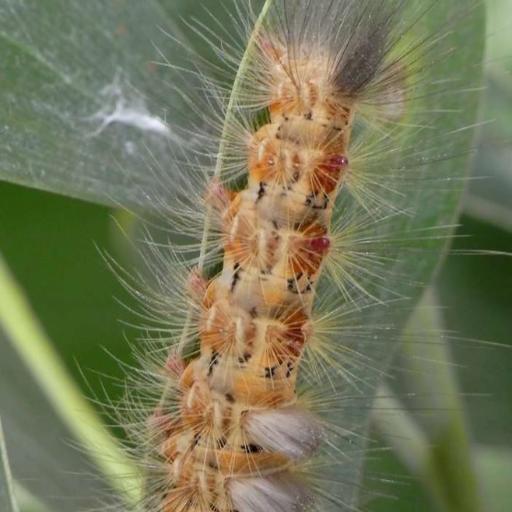
- 🐛 The "Toothbrush" Tufts: The most striking feature of the caterpillar is the four dense, upright tufts of cream-colored hair on its back, resembling the bristles of a toothbrush.
- 🐜 Long "Hair Pencils": Look for two long black bundles of hair projecting forward from the head and one projecting backward from the tail, giving it a symmetrical, "double-ended" appearance.
- 🦋 Sexual Dimorphism: Males have intricate brown and orange mottled wings, while adult females lack wings entirely, appearing as soft, oval-shaped sacks covered in fine gray hair.
🌲 Habitat & Ecology
- 🍂 A Generalist Eater: These insects are not picky eaters. In the garden, they thrive on a massive variety of plants, including roses, acacias, eucalyptus, and—as their name suggests—fruit trees like apples and cherries.
- 🏠 Hitchhiking Habit: Because the females cannot fly, the species spreads when egg masses are accidentally moved by humans on garden furniture, shipping containers, or vehicles. In the wild, newly hatched larvae spin silk threads to "balloon" through the wind.
⚠️ Safety & Toxicity
- 🚫 Skin Irritant: The hairs (setae) of the caterpillar are "urticating," meaning they can cause skin irritation, redness, and itching if handled.
- 🐾 Pets & Kids: Keep curious pets and children away from the caterpillars. While not deadly, a brush against their bristles can cause a painful, prickly rash that may last for several hours.
✨ Fun Fact
The female Painted Apple Moth is so specialized for egg-laying that she often never even leaves her own cocoon! After emerging, she emits powerful pheromones to attract a flying male, lays her eggs directly onto the exterior of her old cocoon, and dies shortly after.
More Details







