Info
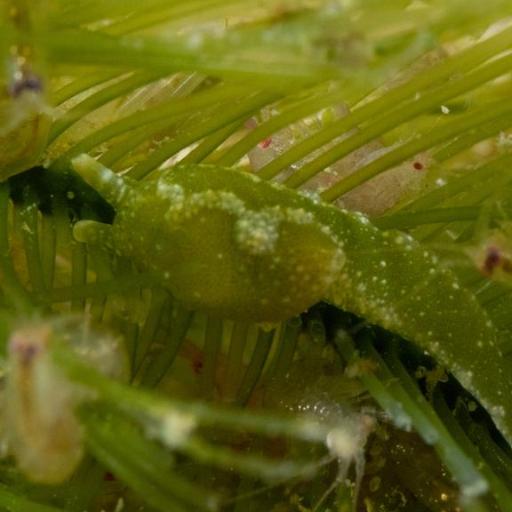
While often mistaken for a peculiar underwater caterpillar or a "sea bug," Oxynoe is actually a genus of small, vibrant sea slugs known as "Ox-ear slugs." These fascinating marine gastropods are masters of mimicry, perfectly blending into the lush green seaweed forests they call home. They are famously "solar-powered," stealing the energy-producing cells from the plants they eat to fuel their own bodies.
🔍 How to Identify
- 💚 The "Leaf" Body: They are typically a brilliant emerald green, often decorated with tiny neon blue, white, or yellow spots that mimic the dappled light of the ocean.
- 🐚 The Hidden Shell: Unlike most slugs, Oxynoe possesses a tiny, thin, transparent shell that sits on its back, though it is often partially covered by fleshy folds called parapodia.
- 🦒 The Long Tail: They have a remarkably long, muscular tail that is much longer than their main body, giving them a lizard-like or insect-like silhouette as they crawl.
🌊 Habitat & Ecology
- 🥗 Algae Specialists: These slugs are found exclusively in tropical and subtropical waters, living almost entirely on Caulerpa algae (commonly known as "Sea Grapes").
- 🔋 Kleptoplasty: They don't just eat the algae; they "kidnap" the chloroplasts. These cells continue to photosynthesize inside the slug's body, providing it with extra energy from the sun.
- 🛡️ Masters of Disguise: Because they look exactly like the fronds of the seaweed they eat, they are nearly impossible for predators—or snorkelers—to spot unless they are moving.
⚠️ Safety & Toxicity
- 🧪 Chemical Defense: While they do not bite or sting humans, they are chemically "armed." If threatened, they secrete a thick, milky white mucus that is toxic to fish.
- 🦎 Tail Autotomy: In a move similar to some lizards, Oxynoe can voluntarily break off its own tail if a predator grabs it, allowing the slug to crawl away while the predator is distracted by the wiggling tail.
- 🚫 Handling: They are extremely delicate. While not dangerous to touch, the oils on human skin or the pressure of a finger can easily harm their fragile bodies.
✨ Fun Fact
If an Oxynoe goes without food for a while, it can survive for weeks simply by "basking" in the light, effectively turning itself into a living plant thanks to the stolen chloroplasts in its skin!
More Details








