Info
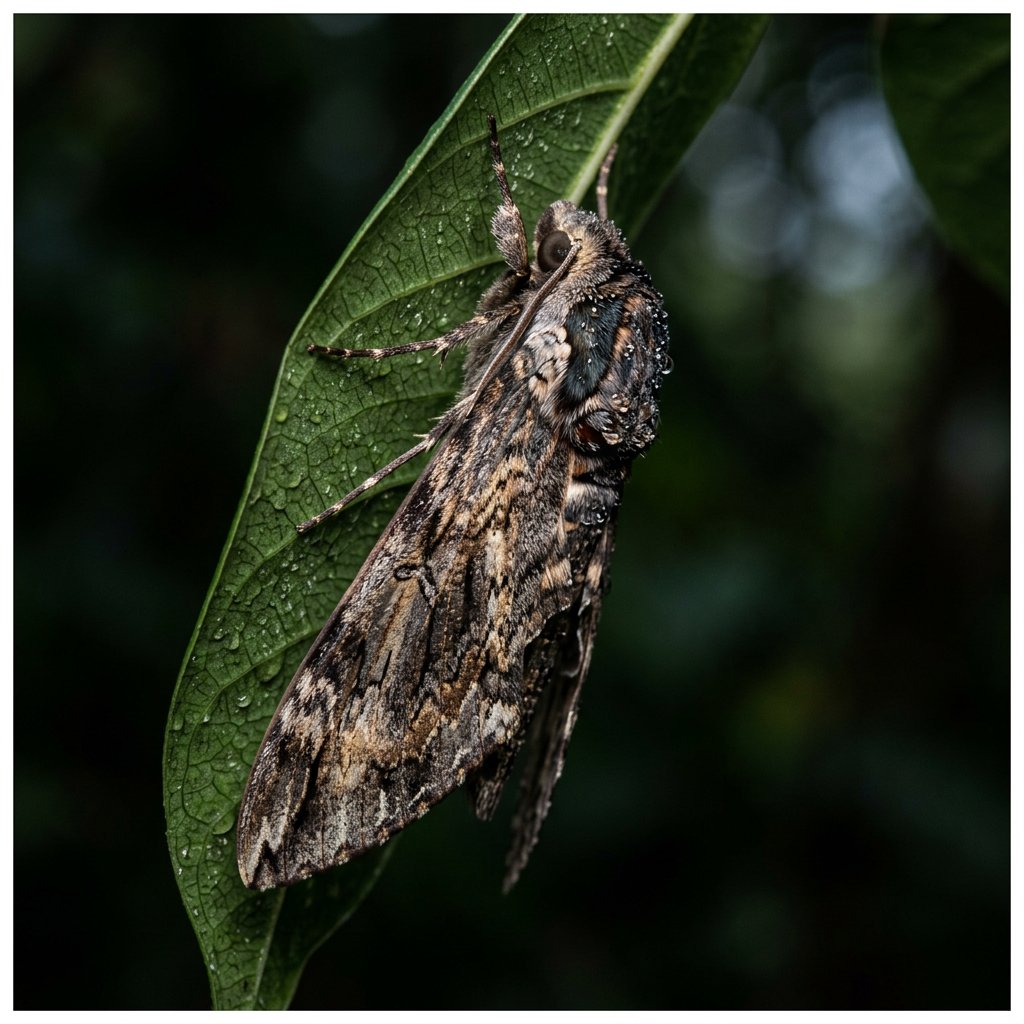
The Fig Sphinx Moth (Pachylia syces) is a master of camouflage that looks more like a piece of weathered driftwood than a living creature. Known for its impressive wingspan and high-speed flight, this moth is a common inhabitant of tropical and subtropical gardens from South America up to the southern United States. While its large size can be startling, it is a gentle giant of the night, playing a vital role as a pollinator for deep-throated flowers.
🔍 How to Identify
- 🦋 The Wings: Broad, powerful wings featuring a mosaic of chocolate browns, ash greys, and charcoal streaks. When resting, the patterns mimic the texture of tree bark perfectly.
- ✈️ Body Shape: A thick, torpedo-shaped abdomen that tapers to a point, designed for aerodynamic, high-speed flight.
- 🐛 The Caterpillar: A vibrant green or lime-colored "hornworm" with a distinctive, soft spike on its rear. They often have subtle diagonal stripes along their sides to blend in with leaf veins.
🌲 Habitat & Ecology
- 🍃 The Fig Connection: As its name suggests, this moth is biologically tied to the Ficus family. The caterpillars feed almost exclusively on the leaves of fig trees, including the common garden varieties and rubber trees.
- 🌙 Nocturnal Navigator: You are most likely to spot them at dusk or dawn. They are attracted to pale, highly fragrant flowers like jasmine or moonflowers, where they hover mid-air to drink nectar using a long, straw-like tongue.
- 🔦 Light Attraction: Like many moths, they are easily disoriented by porch lights. If you find one resting on your wall in the morning, it is simply waiting for the sun to go down to take flight again.
⚠️ Safety & Toxicity
- ✅ Harmless: The Fig Sphinx Moth is completely safe for humans and pets. They do not possess a stinger, and they do not bite.
- 🐛 The "Horn" Bluff: While the caterpillar has a formidable-looking spike on its tail, it is entirely soft and harmless. It is a defensive "bluff" meant to scare off hungry birds, not to cause injury.
✨ Fun Fact
Sphinx moths are often called "Hummingbird Moths" because they are one of the few insects capable of hovering in place and even flying backward, a feat of aerial engineering that requires immense energy and muscle power.
More Details








