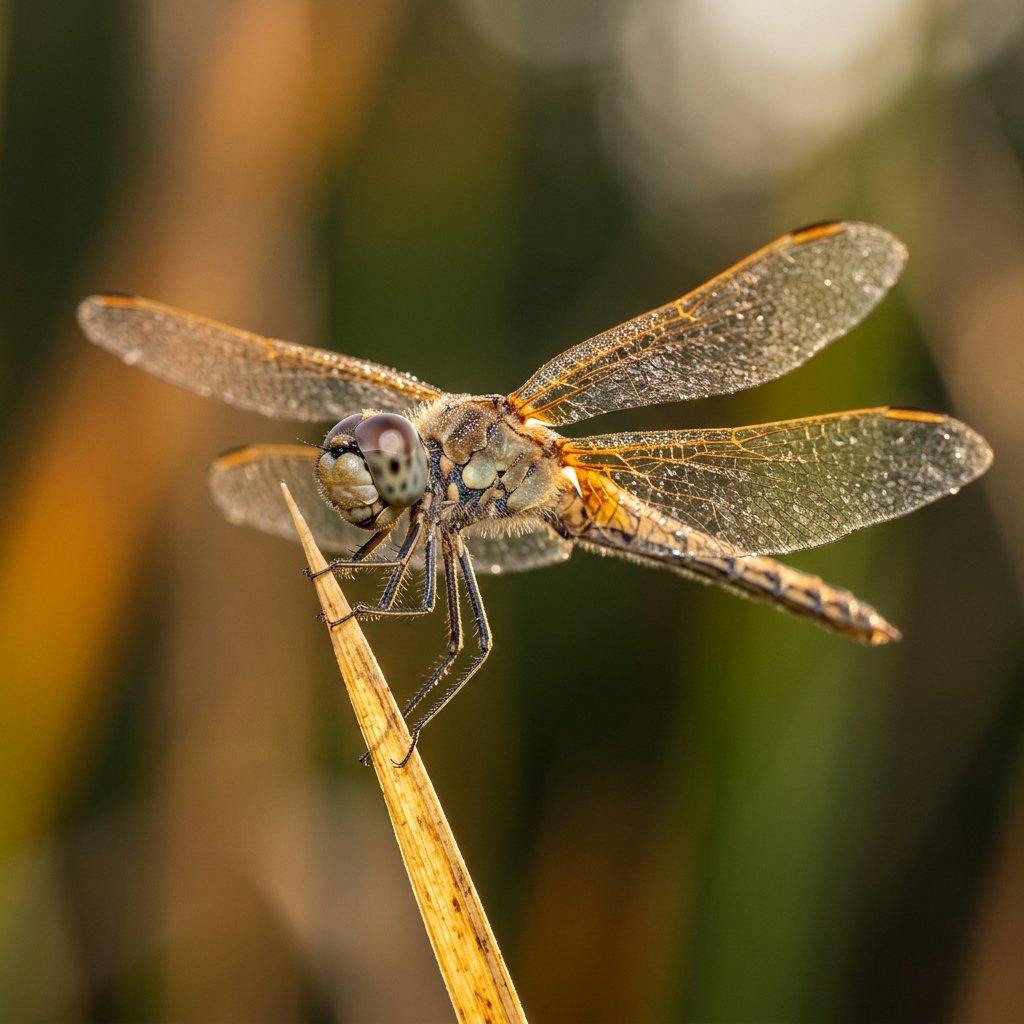
Info
Known as the "Globe Skimmer" or "Wandering Glider," this dragonfly is the ultimate marathon athlete of the insect world. It is famous for its incredible nomadic lifestyle, appearing suddenly in huge swarms following rain clouds and monsoon winds. To many cultures, their arrival signals the change of seasons or the coming of much-needed rain.
🔍 How to Identify
- 🎨 Golden Glow: The body is typically a bright yellowish-orange or golden-brown, often featuring a subtle dark line running down the center of the abdomen.
- ✈️ Gliding Wings: Its hind wings are uniquely broad at the base, acting like efficient sails that allow it to catch wind currents and glide for long distances without flapping.
- 👀 Panoramic Vision: It has massive, reddish-brown eyes that meet at the top of the head, providing an almost 360-degree view of the horizon to spot both prey and predators.
🌲 Habitat & Ecology
- 🌍 The Great Voyager: This insect is found on every continent except Antarctica; it is a "circumtropical" species that utilizes temporary rain puddles and swimming pools to lay eggs, as these spots are often free of hungry fish.
- 🦟 Mosquito Hunter: They are highly beneficial aerial predators that spend most of their lives on the wing, patrolling gardens and marshes to snatch mosquitoes, gnats, and flies right out of the air.
⚠️ Safety & Toxicity
- 🛡️ Completely Harmless: The Globe Skimmer is a "friend" to humans. It does not have a stinger and lacks the jaw strength to bite a person unless it is being handled very roughly.
- ✅ Eco-Indicator: Their presence is a sign of a healthy, functioning ecosystem. They pose no threat to pets, children, or garden plants; in fact, they protect your plants by eating leaf-munching pests.
✨ Fun Fact
The Globe Skimmer holds the world record for the longest migration of any insect! Research shows they travel over 11,000 miles (18,000 km) across the Indian Ocean from India to Africa and back—a journey even more grueling than that of the famous Monarch butterfly.
More Details








