Info
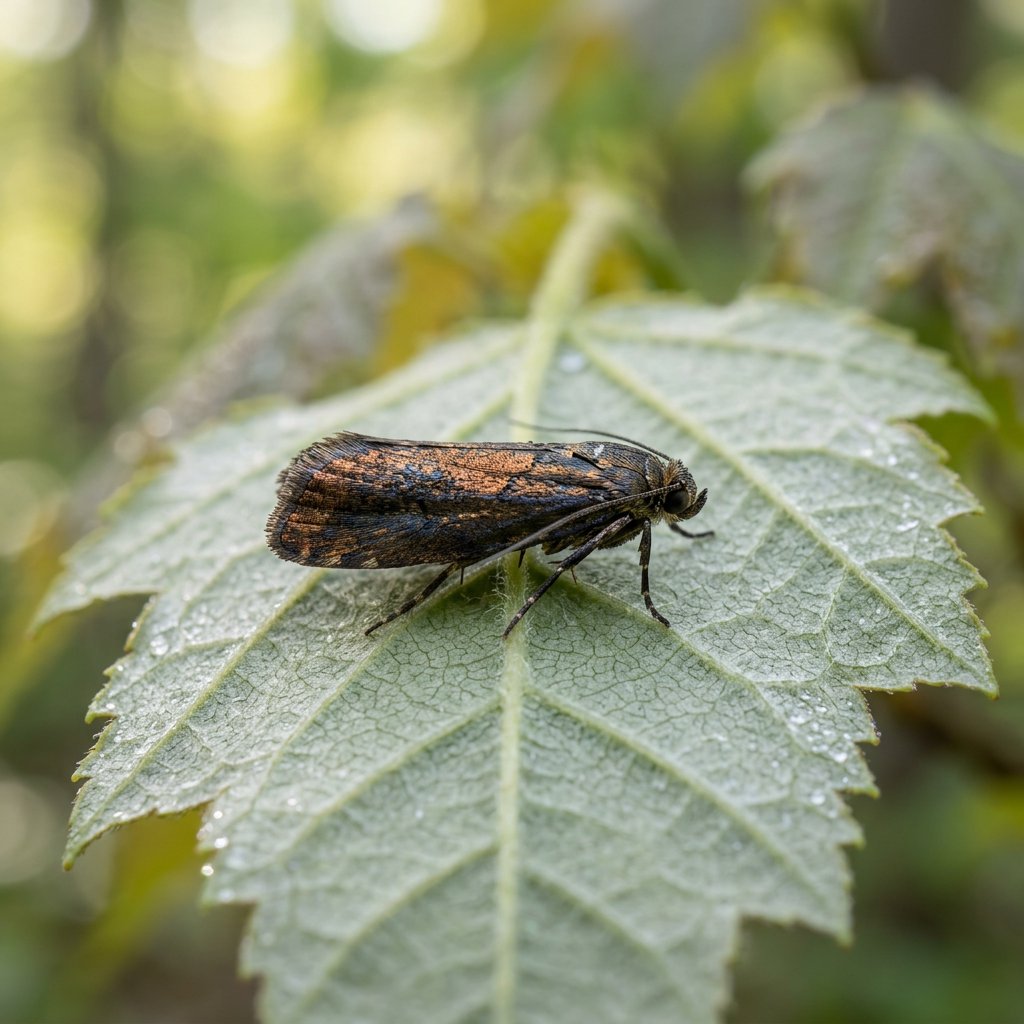
Often called the Maple Leafcutter, this tiny architect is more famous for its handiwork than its face. While the adult moth looks like a shimmering piece of jewelry, its larvae are the ones that leave a "Swiss cheese" trail across your favorite maple trees. They are master craftsmen of the insect world, literally cutting out pieces of their environment to build mobile homes.
🔍 How to Identify
- 🦋 Metallic Wings: The adult moths are small but striking, featuring iridescent steel-blue or greenish-black wings that glint with a metallic sheen in the sunlight.
- 👑 The Golden Crown: You can recognize the adult by the distinct, fuzzy tuft of bright orange or yellowish hair on top of its head, which contrasts sharply with its dark body.
- ⭕ The Signature Hole: On maple leaves, look for perfectly circular holes (about 1/2 inch wide). These look as if someone used a hole-puncher on the foliage, often surrounded by a ring of "skeletonized" (brown, scraped) leaf tissue.
🌲 Habitat & Ecology
- 🍁 Maple Specialist: This moth is a specialist that primarily targets Sugar Maples, though it will occasionally feast on Red Maples or Beech trees during large population spikes.
- 🛡️ The Leaf Sandwich: The larvae are "case-bearers." After feeding inside the leaf, they cut out two circular discs of leaf tissue and silk them together to create a flat, protective pouch. They carry this "sandwich" around for protection as they feed on the leaf surface.
- 🍂 Forest Floor Dweller: After they finish feeding in late summer, the larvae drop to the ground. They spend the entire winter tucked inside their leaf cases beneath the snow, waiting for spring to emerge as moths.
⚠️ Safety & Toxicity
- ✅ Harmless to Humans: The Maple Leafcutter is completely harmless to people and pets. They do not bite, sting, or possess any irritating hairs.
- 🌳 Tree Impact: While a heavy infestation can make a maple tree look "tattered" or scorched, it is rarely fatal. Most healthy trees can handle the leaf loss without long-term damage, though it may slightly slow the growth of very young saplings.
✨ Fun Fact
The Maple Leafcutter is a literal "cut-and-paste" artist of the forest; it uses its own food source to build its house, wearing its lunch as a suit of armor to hide from hungry birds!
More Details








