Info
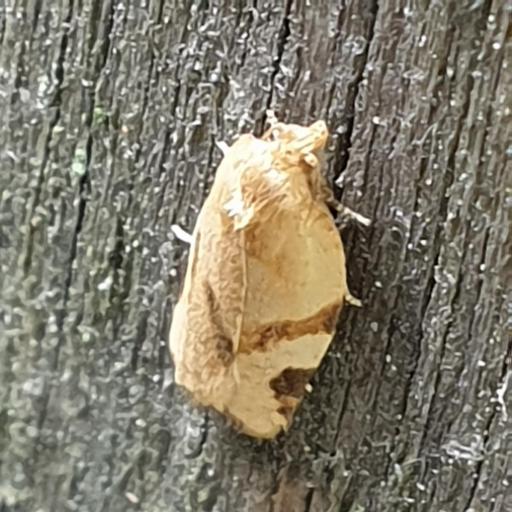
Often called the Gnomana Tortrix, this moth is a subtle resident of European and Asian woodlands and gardens. It is a master of camouflage, masquerading as a tiny, withered fragment of a leaf to evade hungry predators. While it might look like a simple brown moth at first glance, its intricate patterns and "bell-shaped" silhouette make it a fascinating find for any backyard explorer.
🔍 How to Identify
- 📐 Bell Shape: When at rest, its wings create a distinctive flattened "bell" or "delta" profile, a hallmark of the Tortrix family.
- 🎨 Mottled Patterns: The forewings are typically a warm ochre or tan, marked with two darker, diagonal bands that often form a subtle "V" or "X" shape when the moth is settled.
- 📏 Petite Stature: This is a small insect, with a wingspan usually measuring between 15mm and 20mm, making it look like a mere speck of bark on a tree trunk.
🌲 Habitat & Ecology
- 🥗 The Leaf-Roll Architect: As a caterpillar, this insect is a "leafroller." It uses high-tension silk to curl the edges of a leaf into a protective tube, creating a private bunker where it can feed safely on plants like bilberry, wild cherry, and bramble.
- 🌙 Nocturnal Resident: The adults are most active during the twilight hours from late spring through mid-summer. During the day, they prefer to hide in the shaded foliage of deciduous trees or among low-growing shrubs.
⚠️ Safety & Toxicity
- ✅ Status: Completely harmless.
- 🛡️ Gentle Nature: This moth lacks any ability to bite, sting, or irritate the skin. It is neither a significant agricultural pest nor a threat to your home, acting mostly as a minor participant in the local food web.
✨ Fun Fact
The silk used by the larvae is so strong that as it dries, it naturally shrinks, doing the hard work of "rolling" the leaf for the caterpillar automatically!
More Details








