Info
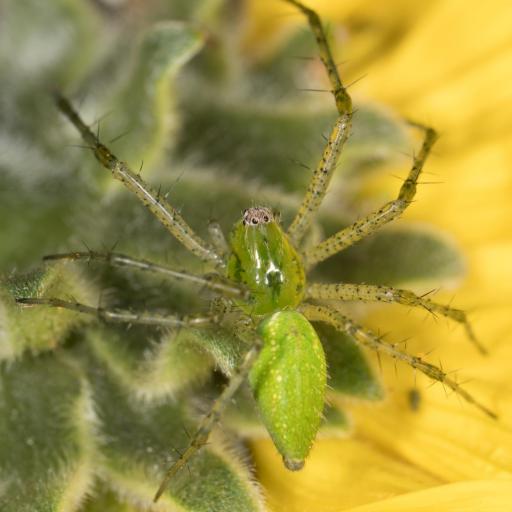
Known as the Lesser Green Lynx Spider, this translucent emerald hunter is the "speedster" of the garden. While many spiders wait patiently in sticky webs, this one relies on its incredible eyesight and lightning-fast legs to chase down its dinner. It is a master of camouflage, blending so perfectly with green foliage that you might only notice it when it pounces.
🔍 How to Identify
- 🟢 Neon Coloring: Its body is a striking, translucent green, often decorated with tiny red, white, or yellow spots and streaks that mimic the light filtering through leaves.
- 🦵 Spiny Legs: The legs are long and pale, covered in very prominent, stiff black spines (setae) that give the spider a "prickly" or "hairy" appearance.
- 👀 Hexagonal Eye Pattern: Like all lynx spiders, it has eight eyes arranged in a distinctive hexagonal shape on top of its head, granting it nearly 360-degree vision.
🌲 Habitat & Ecology
- 🌿 The Active Hunter: This spider is a gardener’s best friend. It doesn't build a traditional web to catch food; instead, it stalks and leaps onto pests like moths, caterpillars, and beetles.
- 🏡 Shrub Dweller: You will most likely find them on low-growing shrubs, tall weeds, or agricultural crops. They prefer plants with wide leaves where they can hide on the underside or wait in ambush near a flower.
⚠️ Safety & Toxicity
- 🛡️ Non-Aggressive: The Green Lynx is quite shy and will almost always choose to run away or jump to another leaf rather than bite a human.
- 🩹 Mild Reaction: While it does possess venom to paralyze its prey, it is not considered medically significant to humans. If bitten (usually only if squeezed), the sensation is similar to a bee sting—mild swelling and redness that fades quickly.
✨ Fun Fact
The "Longipalpis" in its name refers to the exceptionally long "palps" (the small arm-like appendages near the mouth) found on the males. These look like tiny boxing gloves and are used during their complex, rhythmic mating dances!
More Details








