Info
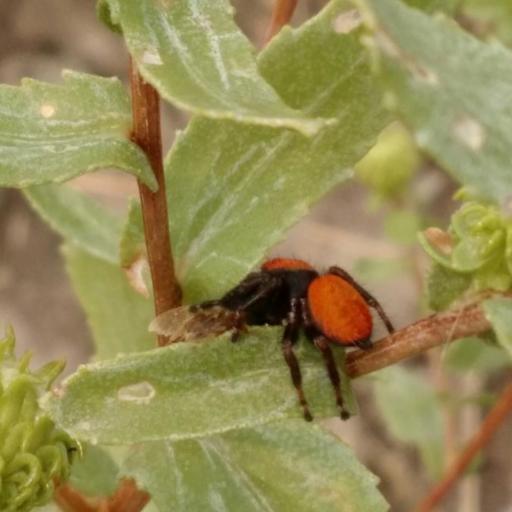
Meet the Apache Jumping Spider, a tiny, fuzzy acrobat that looks like it stepped right out of a superhero comic. Often nicknamed the "Velvet Ant Mimic," this spider is famous for its fiery orange-red coat and its surprisingly charming, curious personality. Unlike many spiders that hide in dark corners, the Apache Jumper is a sun-loving explorer that uses its incredible vision to navigate the world.
🔍 How to Identify
- 🎨 Vibrant Coloring: Adult females and males sport a brilliant solid orange or red "cape" across their back (cephalothorax and abdomen), contrasted against jet-black legs.
- 👀 The "Puppy" Face: They possess two enormous, forward-facing primary eyes that give them a soulful, inquisitive look, accompanied by six smaller eyes for 360-degree motion sensing.
- 💎 Metallic Fangs: Look closely at their mouthparts (chelicerae), and you’ll see a stunning flash of iridescent teal or emerald green.
🦗 Behavior & Ecology
- 🏹 The Precision Hunter: Instead of spinning webs to catch prey, they are active "cat-like" hunters. They stalk their target from a distance before performing a high-speed leap that can be up to 20 times their body length.
- 🎭 Master of Disguise: Their bold red-and-black pattern is actually a survival tactic called Batesian mimicry. They are mimicking the Velvet Ant (a wingless wasp with a legendary sting) to trick birds and lizards into leaving them alone.
- 🧵 The Safety Line: Even though they don't use webs to hunt, they are never without silk. They "anchor" themselves with a silk safety line before every jump, just in case they miss their landing.
⚠️ Safety & Toxicity
- 🟢 Status: Generally harmless and non-aggressive.
- 🐕 Details: While they are venomous (as almost all spiders are), their venom is not medically significant to humans or pets. They are quite shy and would much rather hop away than bite. A bite usually only occurs if they are accidentally crushed against skin and feels similar to a mild bee sting.
✨ Fun Fact
Jumping spiders are considered the most intelligent spiders on the planet! They have been observed planning complex routes to reach prey, including moving out of sight of their target to find a better vantage point—a behavior once thought to be exclusive to "higher" animals.
More Details








