Info
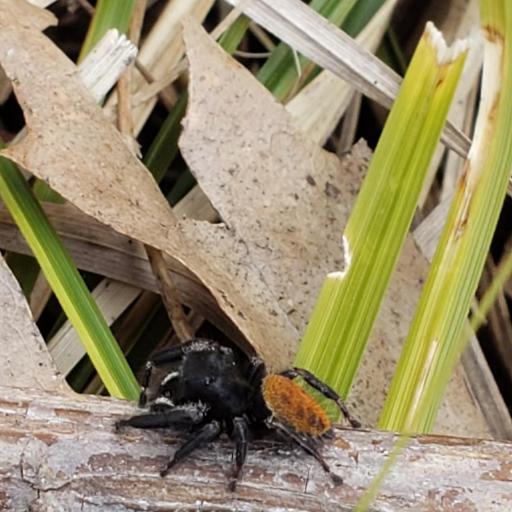
Often called the First Jumper, Phidippus princeps is the charismatic acrobat of the North American meadows. These spiders are famous for their puppy-like curiosity and expressive behavior, often tilting their heads to watch humans with their massive, soulful eyes. Unlike reclusive spiders that hide in dark corners, these are active day-hunters that rely on incredible agility rather than sticky webs to find a meal.
🔍 How to Identify
- 👀 The "Big Eyes" Look: They possess two enormous central eyes that provide high-resolution, 3D vision, flanked by six smaller eyes that give them a nearly 360-degree view of their surroundings.
- 🧥 Fuzzy Camouflage: Their bodies are covered in dense, "hairy" setae, typically in shades of gray, tan, or light brown, which helps them blend perfectly into dried grass and tree bark.
- 💎 Iridescent Mouthparts: Look closely at their "fangs" (chelicerae); in the right light, they often shimmer with a brilliant metallic green or turquoise hue.
🌲 Habitat & Ecology
- 🌾 The Field Specialist: You will most likely spot them in tall grasses, old fields, or on sun-drenched garden fences where they can bask and stalk prey simultaneously.
- 🧗 The Bungee Jumper: They do not spin traditional circular webs to catch food. Instead, they attach a "dragline" of silk to a surface before they leap, acting as a safety rope in case they miss their target.
- 🦟 Pest Control: As active predators, they are excellent at keeping garden pests in check, hunting everything from flies and moths to small crickets.
⚠️ Safety & Toxicity
- ✅ Friend of the Gardener: These spiders are non-aggressive and typically prefer to hop away rather than confront a human. They are considered very safe to have around the home.
- 🕷️ Minimal Risk: While they can bite if they are accidentally squeezed, their venom is weak and not medically significant to humans. For most people and pets, a bite is less painful than a bee sting and results in only minor redness.
✨ Fun Fact
Jumping spiders are widely considered the most intelligent spiders in the world; researchers have found that they can plan complex hunting routes and are even capable of "learning" to recognize certain shapes or colors!
More Details








