Info
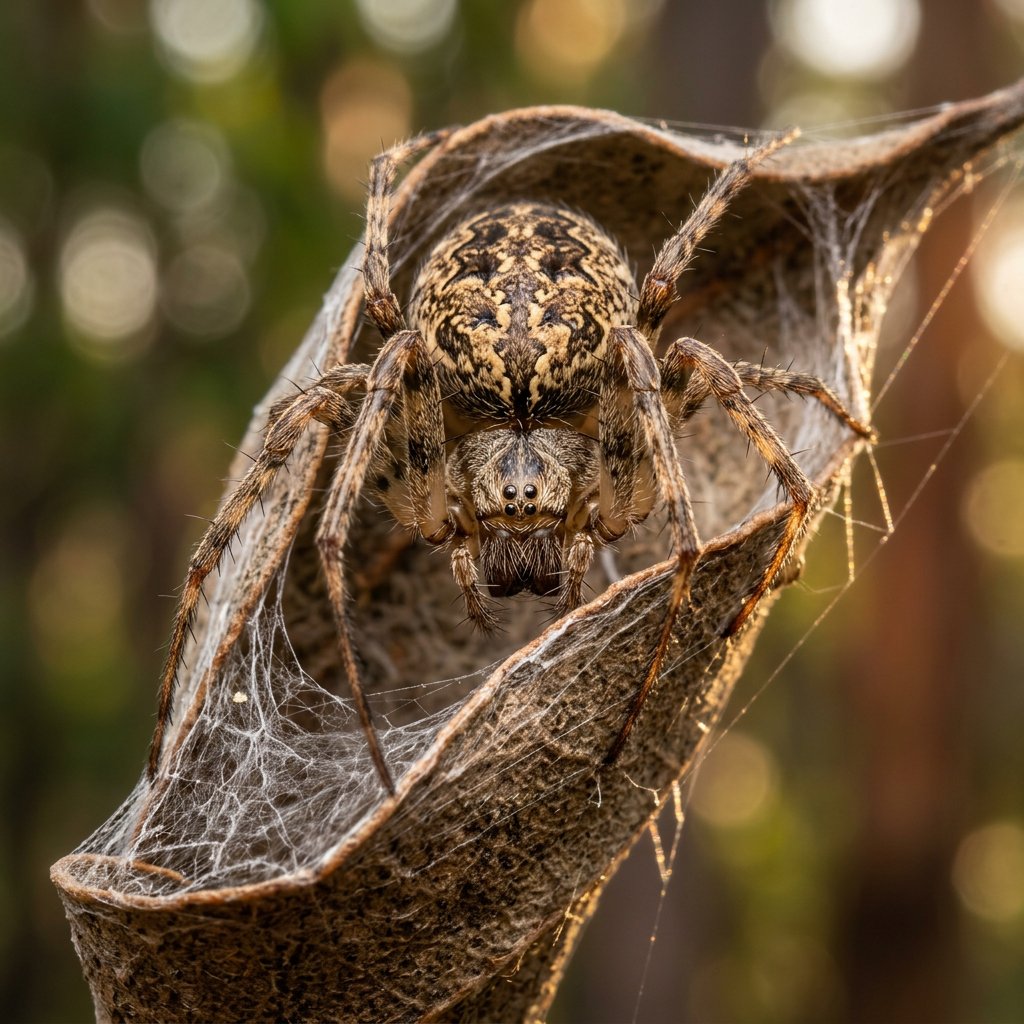
The Leaf-curling Spider, known to scientists as Phonognatha graeffei, is one of nature’s most industrious recyclers. While most spiders hide under leaves or in crevices, this clever architect brings its home right to the center of its web. By hoisting a fallen leaf from the ground and silk-stitching it into a cozy, protective cylinder, it creates a perfect "front porch" from which to survey its domain.
🔍 How to Identify
- 🏠 The Leaf Retreat: The most obvious giveaway is a single, tightly curled dead leaf suspended right in the middle of a circular (orb) web.
- 🕷️ Body Pattern: The spider itself has a creamy-white or yellow abdomen decorated with brown wavy patterns, while its legs and head (cephalothorax) are typically a warm reddish-brown.
- 🧶 The Silk "Telegraph": Look for a "signal line" of silk that runs from the curled leaf to the outer edges of the web; the spider holds onto this line while hiding inside to feel the vibrations of trapped prey.
🌲 Habitat & Ecology
- 🕸️ Master Architect: These spiders are common in Australian woodlands and urban gardens. They aren't picky about their building materials—if a leaf isn't available, they’ve been known to use snail shells, scraps of paper, or even discarded bus tickets!
- 🦟 Aerial Predator: They act as natural pest controllers, sitting tucked away in their leaf tunnel while waiting for flies, moths, and other small winged insects to bumble into their sticky silk trap.
- 🦅 Stealth Mode: The leaf isn't just a house; it’s a fortress. By hiding inside a dead leaf, the spider becomes invisible to predatory birds and parasitic wasps that would otherwise see it as a snack.
⚠️ Safety & Toxicity
- 🛡️ Status: Generally harmless and very shy. They are not aggressive and will retreat further into their leaf home if disturbed.
- 🩹 Details: While they are technically venomous (like almost all spiders), their bite is not considered medically significant to humans. At most, a bite might cause local pain or slight swelling, similar to a bee sting. They are safe to have in the garden, though curious pets might get a tiny nip if they try to "crunch" the spider's leaf house.
✨ Fun Fact
Unlike many other orb-weaving spiders that rebuild their entire web every single night, the Leaf-curling Spider is a bit more economical—it will often keep its leaf home for a long time, simply repairing the surrounding web as needed.
More Details








