Info
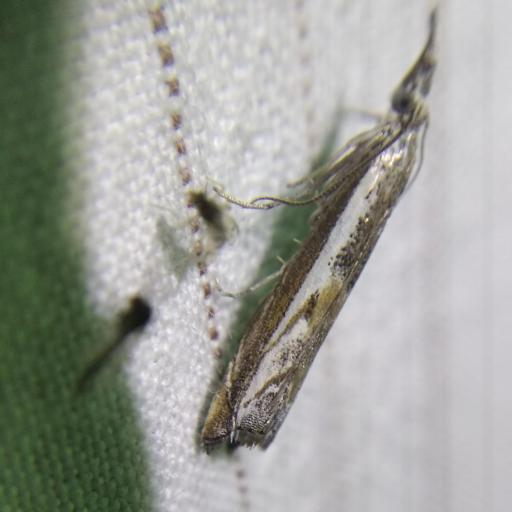
Known as the Alpine Pearl, this delicate member of the grass moth family is a master of disguise. Despite its sophisticated name, it is a rugged survivor often found clinging to blades of grass in sandy coastal regions or heathlands. While its elongated face might look strange at first glance, it is entirely harmless and serves as a vital part of the local ecosystem.
🔍 How to Identify
- 👃 The "Snout": It possesses exceptionally long labial palps that protrude forward from the head, making the moth look like it has a pointed nose or "snout."
- 🎨 Silvery Streaks: The forewings are typically a warm buff or golden-brown, marked with a distinct, shimmering white longitudinal stripe that catches the light.
- 📏 Slim Profile: When resting, it rolls its wings tightly against its body, creating a narrow, stick-like silhouette that blends perfectly with dry grass.
🌲 Habitat & Ecology
- 🌿 Moss Specialist: Unlike many garden pests, the larvae of the Alpine Pearl are specialists that feed primarily on mosses (like Syntrichia) that grow in well-drained, sandy soils.
- 🌙 Night Life: While it is mostly active after dusk—frequently visiting porch lights—it is easily "flushed" from its hiding spots in the grass during the day, where it will take short, low-level flights.
- 🏖️ Coastal Wanderer: Interestingly, you are far more likely to find this "Alpine" moth at sea level in sand dunes than on a mountain peak; it thrives in open, sunny environments with sparse vegetation.
⚠️ Safety & Toxicity
- ✅ Completely Harmless: The Alpine Pearl is a "friend" in the garden. It does not bite, sting, or possess any chemical defenses that could harm humans.
- 🐾 Non-Toxic: It is not known to be toxic to pets or livestock. It is a natural food source for bats and birds, playing a quiet role in the food chain.
✨ Fun Fact
The name "alpinella" is a bit of a historical "oops"—it was named when researchers thought it was a high-altitude specialist. In reality, it is much more of a beach-lover, frequently found in coastal sand dunes across Europe!
More Details








