Info
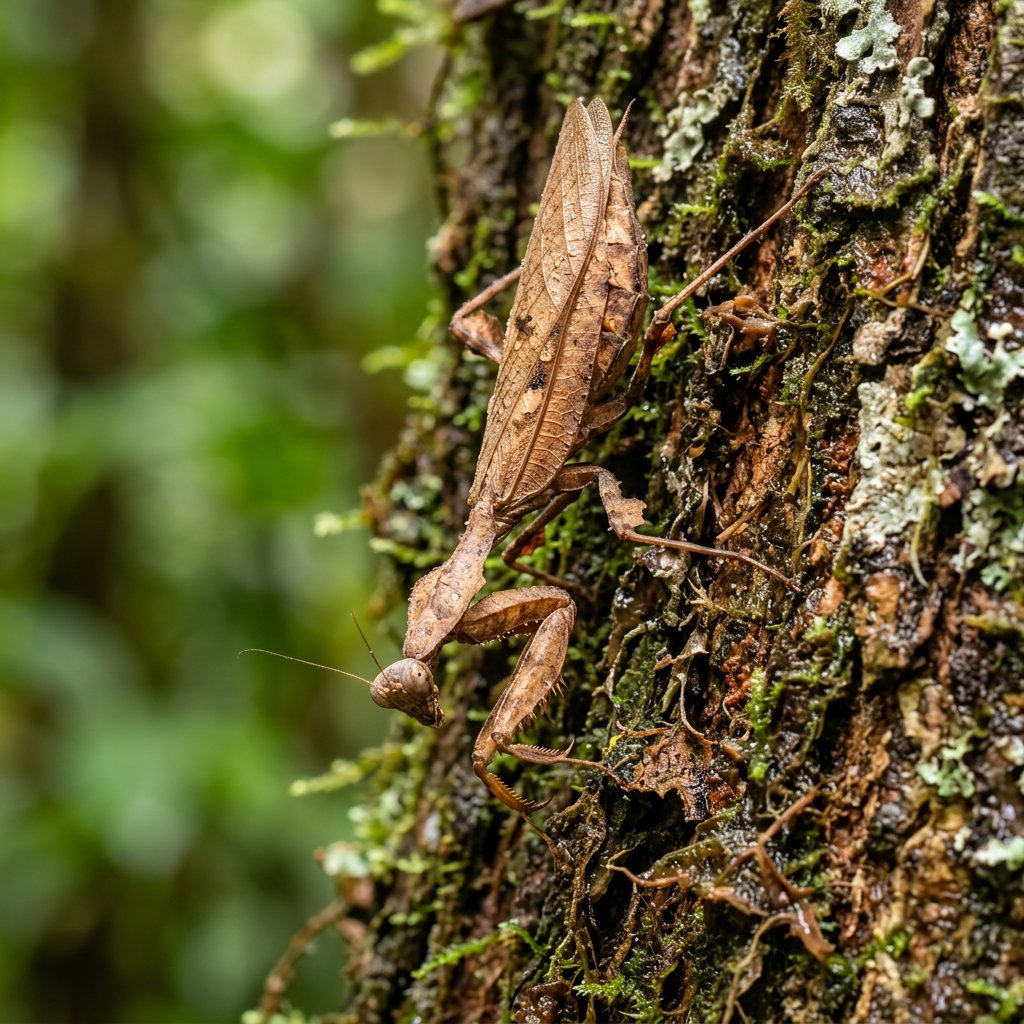
Known as the Texas Unicorn Mantis, this insect looks more like a piece of drift-wood or a collection of dried leaves than a living predator. It is a master of mimicry, blending perfectly into the scrublands of the Southern United States and Mexico. While its "horn" and alien-like appearance might seem intimidating, it is a fascinating "friend" to gardeners, acting as a natural form of pest control.
🔍 How to Identify
- 🦄 The "Unicorn" Horn: The most striking feature is a small, prominent protrusion between the antennae, giving it its mythical namesake.
- 🍃 Leaf-like Lobes: Its legs are equipped with flattened, leaf-like structures (flanges) that break up its silhouette, making it look like a jagged twig.
- 📏 Elongated Prothorax: It has an exceptionally long "neck" (prothorax), which allows it to swivel its head with incredible range to spot prey or threats.
🌲 Habitat & Ecology
- 🎯 The Patient Hunter: Unlike more aggressive mantids, the Texas Unicorn Mantis is a passive ambush predator. It will sit motionless for hours, waiting for a fly or moth to wander within reach of its lightning-fast front legs.
- 🌳 Arboreal Lifestyle: You will typically find them perched on the outer branches of trees or shrubs. They prefer environments with plenty of twigs and dead leaves where their brown and green mottled coloring provides perfect camouflage.
⚠️ Safety & Toxicity
- ✅ Harmless Friend: This insect is completely non-toxic and lacks a stinger. It is not aggressive toward humans and will usually try to hide or play dead if it feels threatened.
- 🤏 Minor Pinch: While it has powerful raptorial legs for catching bugs, a "bite" or pinch to a human is rare and generally feels like a tiny prick, not enough to break the skin or cause lasting pain.
✨ Fun Fact
When the Texas Unicorn Mantis feels a breeze, it will often rock back and forth rhythmically. This "dance" is actually a survival tactic—it is mimicking a dead leaf or twig swaying in the wind to remain invisible to birds and other predators.
More Details








