Info
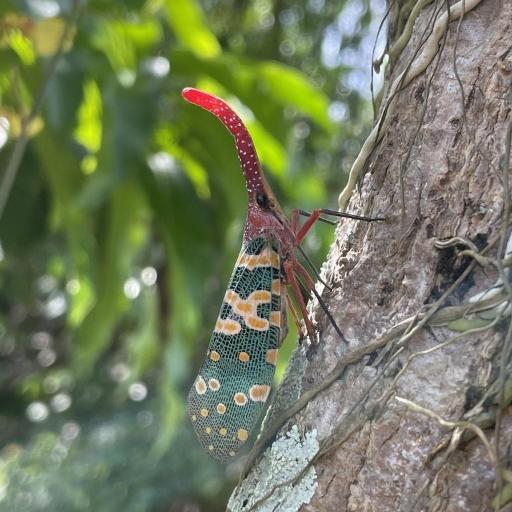
Often called the Long-nosed Lanternfly, this insect looks like it stepped straight out of a fantasy film. Despite its name, it doesn't actually glow in the dark; instead, it "lights up" the tropical forests of Southeast Asia with its brilliant, neon-like colors. It is a master of camouflage that reveals a rainbow of hidden hues the moment it takes flight.
🔍 How to Identify
- 👃 The "Snout": Its most famous feature is the long, reddish-orange protrusion curving upward from its head. While it looks like a nose or a horn, it is actually an extension of the forehead.
- 🦋 Forewings: When resting on a tree, you’ll see dark greenish-black wings covered in bright yellow or white circular spots, designed to mimic lichen or bark.
- 🌈 The Hidden Reveal: Beneath the camouflage lie the hind wings, which are a striking, saturated yellow-orange with deep black tips, used to startle predators when the insect suddenly jumps.
🌲 Habitat & Ecology
- 🌳 The Sap Specialist: As a member of the planthopper family, it is a "true bug" that feeds by piercing tree bark to drink sap. It is particularly fond of Longan and Lychee trees, making it a common resident of tropical fruit orchards.
- 🏃 The Squirrel Maneuver: These insects are shy. If you approach one on a tree trunk, it will quickly shuffle to the opposite side of the tree to stay out of your line of sight, much like a squirrel.
- 💧 Honeydew Producer: Like many sap-suckers, they excrete a sugary liquid called honeydew, which often attracts ants and even some species of geckos that follow them for a free meal.
⚠️ Safety & Toxicity
- ✅ Status: Completely harmless to humans.
- 🚫 Non-Aggressive: Despite the "scary" horn on its face, the Lanternfly has no stinger and does not bite. It is a peaceful herbivore that relies entirely on camouflage and powerful jumping legs for defense.
- 🍏 Garden Impact: While they are beautiful, in large numbers they can weaken fruit trees by draining too much sap, though they are rarely considered a major agricultural pest.
✨ Fun Fact
The name "Lanternfly" comes from a 17th-century mistake! Early naturalists, including Carl Linnaeus, believed the long snout emitted a bioluminescent glow at night to attract mates. While we now know the snout is completely dark, the magical name has stuck for over 250 years.
More Details








