Info
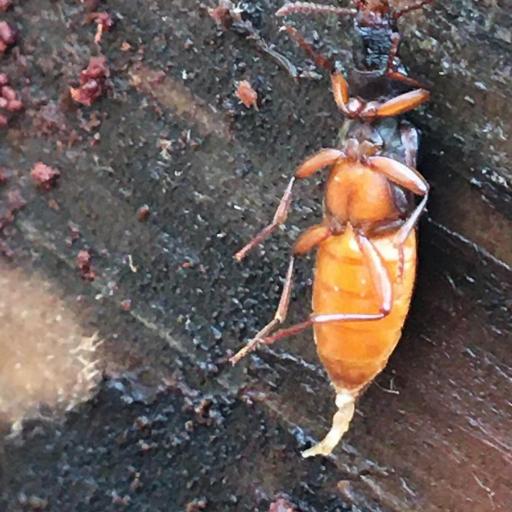
Often called "Flat Bark Beetles," members of the Pythidae family are the ultimate masters of the "tight squeeze." These specialized insects spend almost their entire lives in the narrow, pressurized world between a tree's wood and its bark. To the casual observer, their elongated, flattened bodies might look a bit intimidating, but they are actually essential forest janitors that help turn old wood back into soil.
🔍 How to Identify
- 🪲 Flattened Profile: Their most striking feature is how incredibly thin they are from top to bottom—perfectly evolved for sliding into bark crevices.
- 🛡️ The "Shoulders": Look at the area behind the head (the pronotum); it is often distinctively shaped, sometimes with small teeth or a narrowed "neck" that separates the head from the body.
- 🎨 Metallic Sheen: While many are a dull, camouflaged brown or black to match the trees, some species sport a beautiful, subtle metallic blue or bronze luster.
🌲 Habitat & Ecology
- 🪵 Conifer Specialists: You are most likely to find them in cool, temperate forests. They have a strong preference for fallen or dying coniferous trees like Pine, Spruce, and Fir.
- 🍴 Forest Recyclers: As larvae, they are primarily scavengers (saprophagous), munching on the decaying inner layers of bark. Some species are even known to be opportunistic predators, snacking on the larvae of other wood-boring beetles.
- 🌑 Shadow Dwellers: Because they are "sub-cortical" (living under bark), they are rarely seen in the open unless a log is rolled over or a piece of bark is peeled back.
⚠️ Safety & Toxicity
- ✅ Harmless Neighbor: Pythidae beetles are completely safe for humans. They do not possess a stinger, and their mandibles are designed for wood and decay, not for biting skin.
- 🐾 Pet & Garden Friendly: They are not considered "pests" because they do not attack healthy, living garden plants or structural timber in homes. They are strictly focused on the natural decomposition process in the wild.
✨ Fun Fact
❄️ Some species in this family are high-altitude survivalists! They produce a natural "antifreeze" (polyols and thermal hysteresis proteins) in their bodily fluids, which allows them to survive brutal winters in places like Alaska and Siberia without their internal cells freezing solid.
More Details








